
Equipment
Ingredients
Naan Dough
- 300 g all-purpose flour
- 4 g active dry yeast
- 5 g granulated sugar
- 120 ml water, warm
- 60 g plain yogurt, room temperature
- 4 g salt
- 30 g ghee, melted
Curry Aromatics and Spices
- 30 ml vegetable oil
- 150 g onion, finely diced
- 15 g garlic, minced
- 15 g ginger, minced
- 4 g cumin seeds
- 8 g garam masala
- 5 g coriander powder
- 3 g turmeric powder
- 2 g chili powder
Curry Vegetables and Base
- 400 g crushed tomatoes
- 250 ml vegetable broth
- 200 ml coconut milk, full fat
- 300 g potatoes, peeled and diced into 2cm cubes
- 300 g cauliflower, cut into bite-sized florets
- 150 g carrots, peeled and sliced into rounds
- 100 g frozen peas
- salt
Garnish
- 10 g fresh cilantro, roughly chopped
- 15 ml lemon juice
Nutrition (per serving)
Nutrition is estimated per serving. Nutrients without complete source data are omitted.
Full nutrition
- Calories
- 715 kcal
- Protein
- 18 g
- Carbohydrates
- 102 g
- Fat
- 29 g
- Fiber
- 12 g
- Sugar
- 14 g
- Sodium
- 1388 mg
- Saturated Fat
- 16 g
- Monounsaturated Fat
- 1 g
- Polyunsaturated Fat
- 1 g
- Cholesterol
- 2 mg
- Potassium
- 1451 mg
- Calcium
- 152 mg
- Iron
- 6.5 mg
- Magnesium
- 116 mg
- Phosphorus
- 321 mg
- Zinc
- 2.4 mg
- Vitamin A
- 496 mcg
- Vitamin C
- 75 mg
- Vitamin D
- 0.0 mcg
- Vitamin E
- 0.7 mg
- Vitamin K
- 34 mcg
- Vitamin B6
- 0.6 mg
- Vitamin B12
- 0.1 mcg
- Thiamin
- 0.45 mg
- Riboflavin
- 0.24 mg
- Niacin
- 3.9 mg
- Folate
- 136 mcg
- Water
- 376 g
Sources: Aggregated Public Data, USDA FoodData Central
Method
Combine the warm water (approximately 40C/104F), sugar, and active dry yeast in a mixing bowl. Let the mixture sit undisturbed until it becomes frothy on the surface.
Add the all-purpose flour, plain yogurt, and salt to the yeast mixture. Knead the mixture until a smooth, slightly tacky, and elastic dough forms.
Cover the mixing bowl with a damp cloth and let the dough proof at warm room temperature until it has significantly increased in size.
Heat the vegetable oil in a Dutch oven over medium heat. Add the cumin seeds and toast them briefly until they become aromatic and darken slightly.
Add the finely diced onion, minced garlic, and minced ginger to the Dutch oven. Saute the mixture, stirring frequently, until the onions soften and caramelize.
Stir the garam masala, coriander powder, turmeric powder, and chili powder into the onion mixture. Toast the spices continuously to prevent burning.
Pour the crushed tomatoes and vegetable broth into the pot, stirring to scrape up any browned bits from the bottom. Bring the liquid to a gentle boil.
Add the diced potatoes and sliced carrots to the bubbling tomato base. Reduce the heat to low, cover the Dutch oven, and simmer.
Stir the cauliflower florets and coconut milk into the curry. Keep the pot uncovered and continue to simmer until all the root vegetables and cauliflower are completely cooked.
Stir in the frozen peas and season the curry with salt to taste. Allow the curry to simmer just long enough to warm the peas through, then remove the pot from the heat.
Turn the proofed naan dough out onto a lightly floured surface. Divide the dough into four equal portions and use a rolling pin to roll each piece into a teardrop or oval shape, about half a centimeter thick.
Heat a dry cast iron skillet over medium-high heat until very hot. Place one rolled naan dough into the skillet and cook until the surface puffs up. Flip the bread to cook the other side.
Remove the cooked naan from the skillet and immediately brush the hot surface with melted ghee or butter. Repeat the cooking and brushing process for the remaining dough portions.
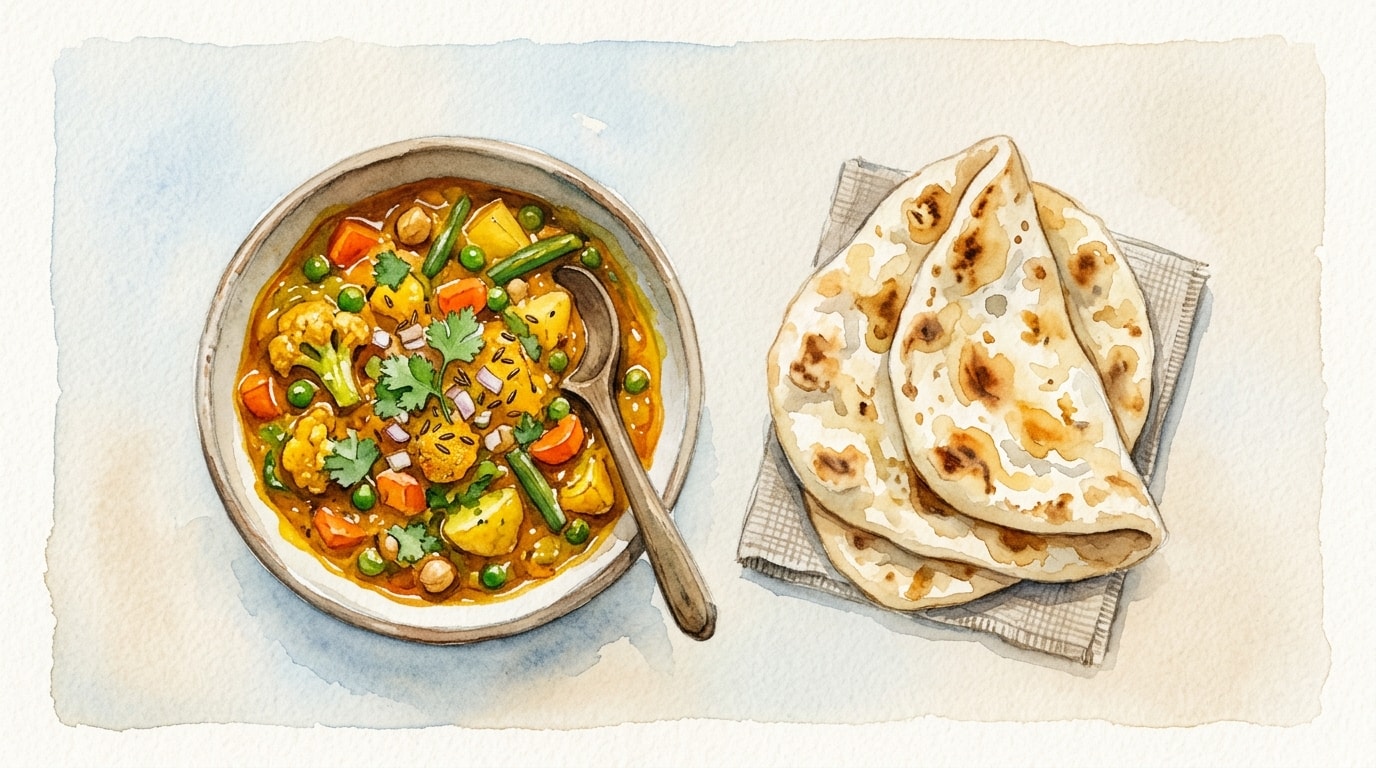
Ladle the hot vegetable curry into deep serving bowls. Top with a squeeze of fresh lemon juice and a scattering of chopped cilantro, serving alongside the warm, freshly cooked naan.
Chef's Notes
- To replicate the characteristic smoky flavor and blistering of a traditional tandoor oven without specialized equipment, ensure your cast iron skillet is preheated completely until a drop of water instantly vaporizes on its surface.
- Blooming the ground spices in the hot oil during the early stages of cooking releases their fat-soluble aromatic compounds, which dramatically deepens the flavor profile of the final curry sauce.
- Cutting the root vegetables and cauliflower into highly uniform pieces is crucial. It ensures everything finishes cooking at the exact same time, preventing a mix of mushy potatoes and unpleasantly crunchy carrots.
- If the curry sauce reduces too much and becomes overly thick while simmering the vegetables, simply splash in a little extra water or vegetable broth to return it to a rich, gravy-like consistency.
Storage
Refrigerator: 4 days — Store curry and naan in separate airtight containers. Naan is best consumed within 2 days.
Freezer: 3 months — Freeze the curry only. The potatoes may change texture slightly upon thawing.
Troubleshooting
Naan is dense and fails to bubble in the pan
Cause: The yeast was inactive, the water used was too hot and killed the yeast, or the skillet was not preheated sufficiently.
Fix: Cannot be fixed once cooked, but the resulting flatbread remains entirely edible and excellent for dipping into the curry sauce.
Prevention: Ensure the water is pleasantly warm but not hot (around 40C/104F) and verify your yeast foams before proceeding. Preheat the cast iron skillet thoroughly.
Vegetables are mushy and falling apart in the curry
Cause: The curry was boiled vigorously instead of gently simmered, or the vegetables were cut into pieces that were too small.
Fix: Remove from heat immediately and stir gently. Serve as a thicker, more rustic stew.
Prevention: Maintain a very gentle simmer once the vegetables are added and cut the root vegetables into sturdy, uniform, bite-sized pieces.
Cultural Context
Curry is an Anglicized term that encompasses a vast array of complex, heavily spiced dishes native to the Indian subcontinent. Naan is a soft, leavened flatbread traditionally baked by slapping the stretched dough directly against the intensely hot interior walls of a cylindrical clay tandoor oven. Preparing these components together from scratch brings the communal, deeply aromatic essence of a traditional Indian meal directly to the domestic kitchen.


