Equipment
* optional
Ingredients
Base
- 45 ml grapefruit juice, freshly squeezed
- 15 g honey
- 5 g dijon mustard
Oil and Seasoning
- 90 ml extra virgin olive oil
- 2 g kosher salt
- 1 g black pepper, freshly ground
Nutrition (per serving)
Nutrition is estimated per serving. Nutrients without complete source data are omitted.
Full nutrition
- Calories
- 86 kcal
- Protein
- 0 g
- Carbohydrates
- 2 g
- Fat
- 9 g
- Fiber
- 0 g
- Sugar
- 2 g
- Sodium
- 84 mg
- Saturated Fat
- 1 g
- Monounsaturated Fat
- 7 g
- Polyunsaturated Fat
- 1 g
- Potassium
- 10 mg
- Calcium
- 2 mg
- Iron
- 0.1 mg
- Magnesium
- 1 mg
- Phosphorus
- 1 mg
- Zinc
- 0.0 mg
- Vitamin A
- 0 mcg
- Vitamin C
- 2 mg
- Vitamin E
- 1.3 mg
- Vitamin K
- 6 mcg
- Niacin
- 0.0 mg
- Folate
- 1 mcg
- Water
- 4 g
Sources: Aggregated Public Data, USDA FoodData Central
Method
In a small mixing bowl, combine the freshly squeezed grapefruit juice, honey, Dijon mustard, kosher salt, and black pepper.
Whisk the mixture vigorously until the honey and salt are completely dissolved and the mustard is fully incorporated into the liquid.
While whisking constantly, slowly drizzle in the extra virgin olive oil in a thin, steady stream. Continue whisking until the dressing is glossy, thickened, and completely emulsified.
Chef's Notes
- Always use freshly squeezed grapefruit juice; bottled versions often undergo pasteurization which mutes the bright, volatile aromatic compounds essential for a vibrant dressing.
- The Dijon mustard is practically undetectable in the final flavor profile but is chemically necessary to stabilize the emulsion between the acidic juice and the oil.
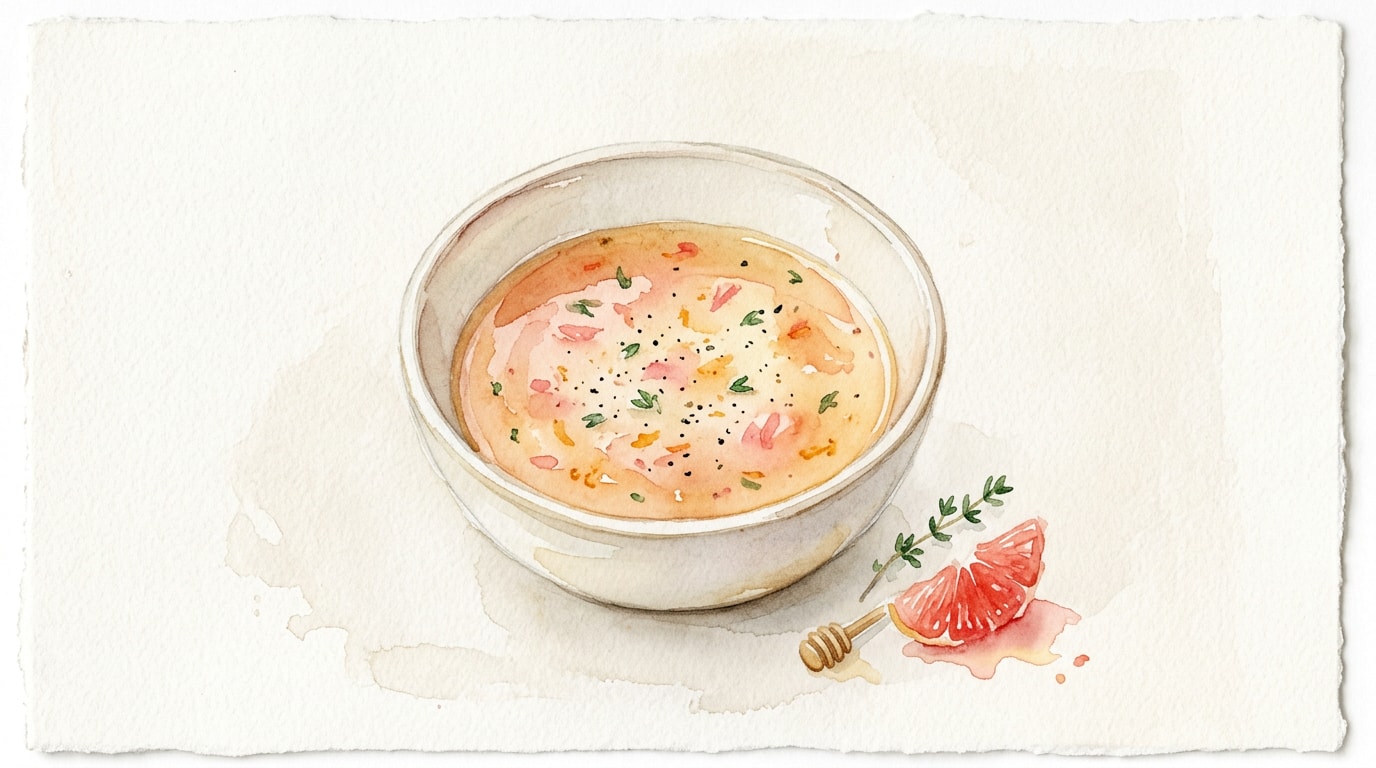
- For variations, consider adding half a teaspoon of finely chopped fresh thyme or a small pinch of poppy seeds to add visual appeal and subtle herbal notes.
- When dressing delicate greens, add the vinaigrette to the bottom of the salad bowl, place greens on top, and toss just before serving to prevent wilting.
Storage
Refrigerator: 1 week — Olive oil may solidify in the fridge. Let sit at room temperature for 15 minutes and shake well before using.
Troubleshooting
The vinaigrette separates into a layer of oil and a layer of juice
Cause: The oil was added too quickly or the mixture was not agitated enough during the addition
Fix: Place a fresh teaspoon of Dijon mustard in a clean bowl. Slowly whisk the broken vinaigrette into the new bowl drop by drop until it re-emulsifies.
Prevention: Add the oil in a very slow drizzle while whisking continuously, or use a secure jar to shake violently
Dressing is overwhelmingly bitter
Cause: The white pith of the grapefruit was pressed into the juice, or the grapefruit variety was overly tart
Fix: Add an extra pinch of salt to suppress the perception of bitterness, and up to 5g more honey if needed.
Prevention: Squeeze the grapefruit gently without pressing the bitter white pith
Cultural Context
Citrus vinaigrettes are a staple of Mediterranean coastal cooking. During the winter months when local citrus is at its peak harvest, cooks utilize the bright acidity of lemons, oranges, and grapefruits to cut through the richness of the region's ubiquitous olive oils, creating lively dressings for robust seasonal vegetables.