Equipment
Ingredients
Crab Bisque Reduction
- 500 g blue crab shells or swimmer crab bodies, crushed
- 30 ml olive oil
- 100 g carrot, chopped
- 100 g onion, chopped
- 80 g fennel bulb, sliced
- 40 g tomato paste
- 60 ml cognac or brandy
- 1000 ml fish stock
- 100 ml heavy cream
Pasta Dough
- 300 g 00 flour
- 6 egg yolks
- 1 whole egg
- 10 ml olive oil
Prawn & Scallop Mousse (Filling & Coating)
- 300 g tiger prawns, peeled and deveined
- 100 g sea scallops
- 1 egg white
- 10 g cornstarch
- 10 g chives, finely minced
- 2 g white pepper
- 4 g salt
Crab Claws Assembly
- 8 crab claws, cooked
- 100 g all-purpose flour
- 2 eggs, beaten
- 200 g panko breadcrumbs
- 1000 ml neutral oil
Nutrition (per serving)
Nutrition is estimated per serving. Nutrients without complete source data are omitted.
Full nutrition
- Calories
- 1251 kcal
- Protein
- 86 g
- Carbohydrates
- 125 g
- Fat
- 41 g
- Fiber
- 7 g
- Sugar
- 9 g
- Sodium
- 2340 mg
- Saturated Fat
- 13 g
- Trans Fat
- 0 g
- Monounsaturated Fat
- 15 g
- Polyunsaturated Fat
- 5 g
- Cholesterol
- 652 mg
- Potassium
- 1629 mg
- Calcium
- 367 mg
- Iron
- 10.0 mg
- Magnesium
- 129 mg
- Phosphorus
- 824 mg
- Zinc
- 9.2 mg
- Vitamin A
- 505 mcg
- Vitamin C
- 19 mg
- Vitamin D
- 2.8 mcg
- Vitamin E
- 6.3 mg
- Vitamin K
- 33 mcg
- Vitamin B6
- 0.7 mg
- Vitamin B12
- 6.6 mcg
- Thiamin
- 1.44 mg
- Riboflavin
- 1.29 mg
- Niacin
- 14.4 mg
- Folate
- 408 mcg
- Water
- 300 g
Sources: Aggregated Public Data, USDA FoodData Central
Method
Prepare the pasta dough: Mound the 00 flour on a work surface, create a well, and add yolks, whole egg, and olive oil. Whisk eggs gradually incorporating flour, then knead by hand for 10 minutes until smooth and elastic. Wrap in plastic and rest at room temperature.
Start the stock: In a large pot, sauté crab shells in olive oil over high heat until they turn bright orange and smell toasted. Add carrots, onions, and fennel; cook for 5 minutes. Stir in tomato paste and cook for 2 minutes to darken.
Deglaze the pot with cognac, scraping the bottom. Add fish stock, bring to a boil, then reduce heat to a simmer. Cook for 45 minutes. Strain through a fine mesh sieve (Chinois), pressing on solids to extract flavor. Return liquid to a clean pot and reduce volume by half.
Make the mousse: In a food processor, blend cold prawns, scallops, egg white, cornstarch, salt, and white pepper until a smooth, tacky paste forms. Fold in minced chives by hand. Keep chilled.
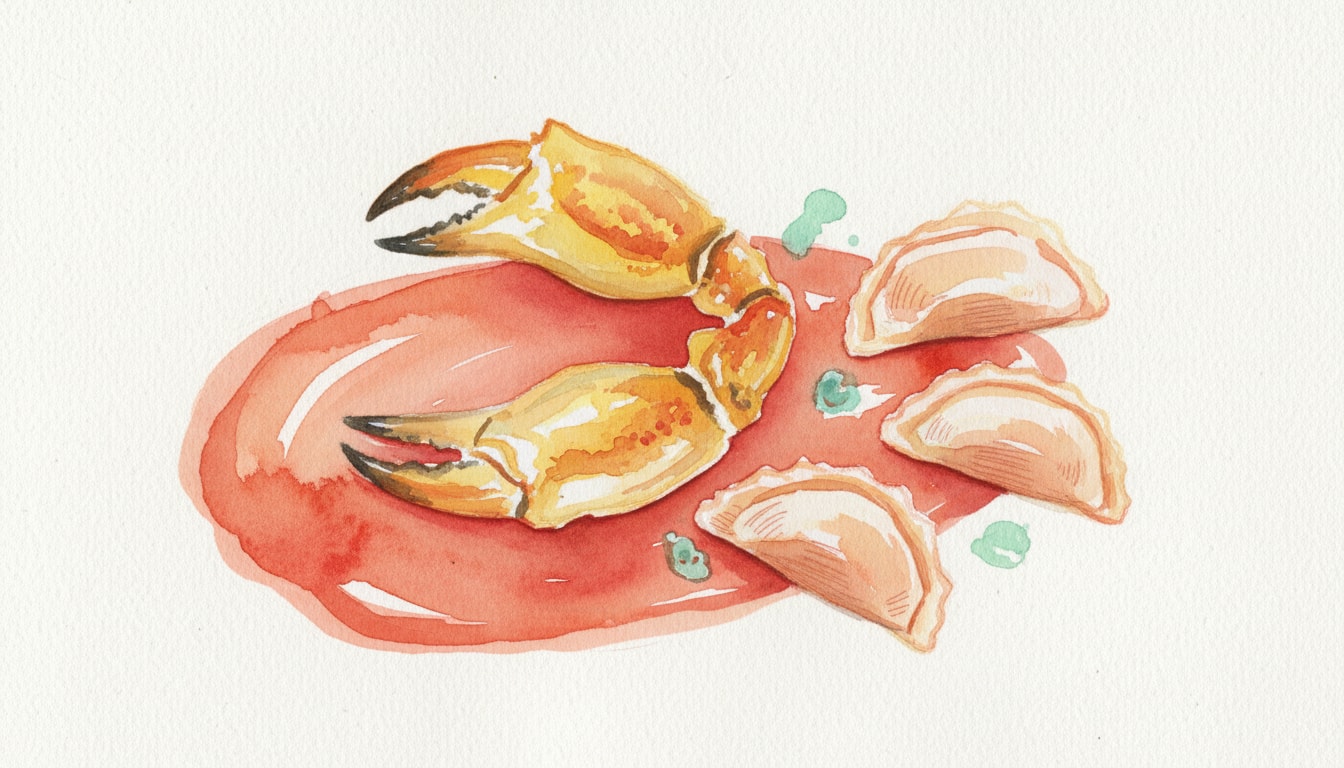
Assemble crab claws: Take approximately 40g of mousse and mold it around the exposed meat of each crab claw, leaving the pincer tip exposed. Shape into a round bulb.
Bread the claws: Dredge each mousse-covered claw in flour, dip completely in beaten egg, and coat thoroughly in panko breadcrumbs. Press breadcrumbs gently to adhere. Chill for 15 minutes.
Make ravioli: Roll pasta dough to the thinnest setting (translucent). Pipe teaspoon-sized mounds of the remaining mousse onto the sheet. Cover with a second sheet, press out air pockets, seal, and cut into desired shapes.
Finish the bisque: Add heavy cream to the reduced stock. Simmer gently until it coats the back of a spoon (nappe). Adjust seasoning with salt to taste.
Fry the claws: Heat oil to 175°C/350°F. Deep fry claws for 4-5 minutes until golden brown and the internal temperature of the mousse reaches 70°C/158°F. Drain on a wire rack.
Boil ravioli in salted water for 2-3 minutes until they float and the dough is al dente. Transfer directly into the bisque sauce to coat.
Plate by arranging ravioli in a shallow bowl with a generous ladle of bisque. Top with two crispy crab claws per serving. Garnish with fennel fronds or extra chives.
Chef's Notes
- Temperature Control: Keep the seafood mousse ingredients as cold as possible (even freeze the processor blade) to prevent the protein from breaking and becoming grainy.
- Shell Roasting: Do not rush roasting the crab shells. Deep browning creates the complex maillard reaction required for a non-watery tasting bisque.
- Pasta Texture: If you don't have time for handmade pasta, use high-quality store-bought wonton skins as a substitute for a lighter, more Asian-leaning dumpling variation.
- Stock Clarity: While this recipe uses cream, you can omit it and whisk in 50g of cold butter at the end for a glossier, sharper shellfish jus.
Storage
Refrigerator: 2 days — Store components separately. Pasta and claws lose texture if stored combined with sauce.
Freezer: 1 month — Uncooked ravioli and breaded (unfried) claws freeze exceptionally well.
Reheating: Re-fry claws to restore crispness. Gently warm sauce. Boil pasta fresh.
Troubleshooting
Mousse falls off the claw during frying
Cause: Air pockets were trapped or the mousse was not cold enough/sticky enough
Fix: Cannot fix once fried; for next batch, double breading (egg-crumb-egg-crumb) can help reinforce the shell
Prevention: Ensure prawns are ice cold when blending; slap the mousse against the bowl to remove air; chill breaded claws before frying
Cultural Context
This dish borrows from the Cantonese dim sum classic 'Jau Yuen' (Deep-fried Crab Claw) where a crab claw is encased in shrimp paste. Here, it is reinterpreted through a French lens, pairing the technique with a classic Bisque and Italian Agnolotti, representing the harmonization of global coastal cuisines.