
Equipment
Ingredients
Meat Block
- 800 g pork shoulder, well-chilled, cut into 2cm cubes
- 200 g pork back fat, well-chilled, cut into 2cm cubes
Seasonings
- 30 g fresh ginger, peeled and very finely minced
- 4 g star anise powder
- 30 ml light soy sauce, chilled
- 15 ml dark soy sauce, chilled
- 15 g kosher salt
- 10 g granulated sugar
- 3 g white pepper, finely ground
- 50 ml ice water
Casings
- natural hog casings
Nutrition (per serving)
Nutrition is estimated per serving. Nutrients without complete source data are omitted.
Full nutrition
- Calories
- 742 kcal
- Protein
- 31 g
- Carbohydrates
- 4 g
- Fat
- 66 g
- Fiber
- 0 g
- Sugar
- 2 g
- Sodium
- 1778 mg
- Saturated Fat
- 24 g
- Monounsaturated Fat
- 30 g
- Polyunsaturated Fat
- 7 g
- Cholesterol
- 136 mg
- Potassium
- 586 mg
- Calcium
- 36 mg
- Iron
- 2.4 mg
- Magnesium
- 41 mg
- Phosphorus
- 328 mg
- Zinc
- 4.7 mg
- Vitamin A
- 5 mcg
- Vitamin C
- 2 mg
- Vitamin D
- 4.0 mcg
- Vitamin E
- 0.3 mg
- Vitamin K
- 0 mcg
- Vitamin B6
- 0.6 mg
- Vitamin B12
- 1.3 mcg
- Thiamin
- 1.27 mg
- Riboflavin
- 0.49 mg
- Niacin
- 6.8 mg
- Folate
- 10 mcg
- Water
- 127 g
Sources: Aggregated Public Data, USDA FoodData Central
Method
Place grinder attachments, mixing bowls, and the meat and fat cubes in the freezer for 30 minutes before beginning. Keeping equipment and ingredients ice cold prevents the fat from melting.
Rinse the hog casings thoroughly under cold running water, running water through the inside of the casing to flush them. Submerge in warm water and let soak.
Grind the chilled pork shoulder and back fat through a medium or coarse (6mm) grinding plate into a bowl set over an ice bath. Maintain meat temperature below 4°C/40°F.
Add minced ginger, star anise powder, light soy sauce, dark soy sauce, salt, sugar, white pepper, and ice water to the ground meat. Mix vigorously by hand for 3-5 minutes until the mixture becomes highly cohesive, tacky, and leaves a sticky protein film on the sides of the bowl.
Load the sticky meat mixture into your sausage stuffer tightly, pressing down to eliminate air pockets. Thread the soaked hog casing onto the stuffing tube, leaving a 5cm tail.
Extrude the meat into the casing slowly, supporting the filled casing with your other hand. Do not stuff too tightly, or the casings will burst during linking. Tie off the ends once fully stuffed.
Pinch the long coil into 12cm links. Twist the first link forward 3-4 times, then the next link backward 3-4 times, continuing this alternating pattern until the entire coil is linked.
Inspect the sausages and prick any visible air pockets with a sterilized needle. Place the linked sausages on a wire rack over a baking sheet and refrigerate uncovered overnight to dry the casings and set the flavor.
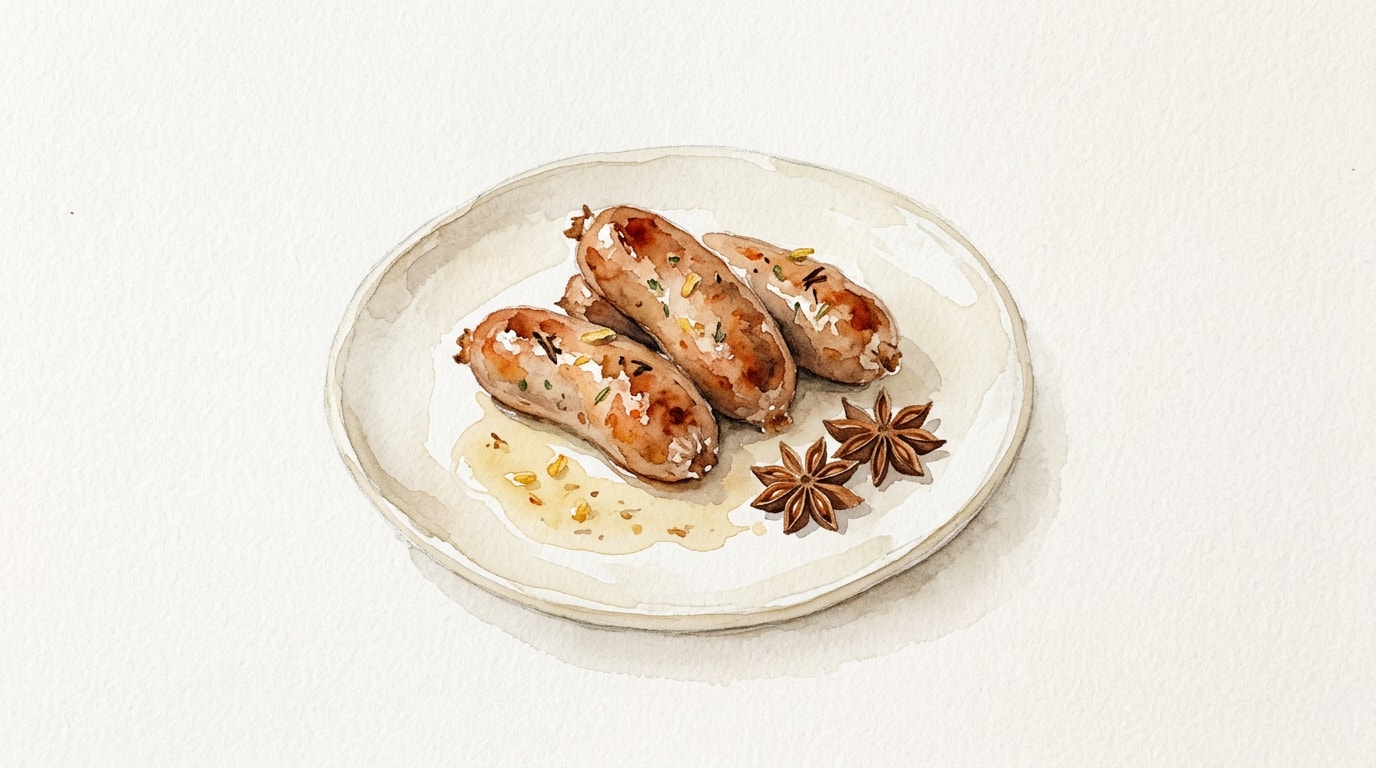
Heat a frying pan over medium-low heat with a splash of oil. Add the sausages and cook gently, turning occasionally, until richly browned and the internal temperature reaches 71°C/160°F. Ensure raw pork is handled with separate utensils.
Chef's Notes
- Temperature is the most critical ingredient in sausage making. An unbroken emulsion between the lean pork, fat, and liquid guarantees a juicy texture, which is impossible to achieve if the fat begins to melt before cooking.
- Do not shortcut the mixing phase (the primary bind). Kneading the meat releases myosin, a protein that acts as the internal glue. It is ready when a handful turned upside-down clings to your palm.
- Resting the sausages uncovered overnight in the fridge performs a dual purpose: it dries the casing for a satisfying snap, and allows the vibrant ginger and deep star anise flavors to bloom fully into the fat.
- Toasting and grinding whole star anise pods immediately before mixing provides a profoundly deeper, more complex flavor profile than stale pre-ground powder.
Storage
Refrigerator: 3 days — Keep tightly wrapped in an airtight container after the initial overnight drying phase.
Freezer: 3 months — Vacuum sealing is highly recommended to prevent freezer burn.
Reheating: Thaw completely in the refrigerator before pan-frying or grilling.
Troubleshooting
Sausage has a dry, crumbly, or mealy texture after cooking.
Cause: The emulsion broke because the meat or fat became too warm during grinding or mixing, causing the fat to separate out (fatting out).
Fix: Cannot be fixed as a sausage. Remove from casings and use crumbled in stir-fries, fried rice, or robust pasta sauces.
Prevention: Keep all meat, fat, and equipment strictly below 4°C/40°F. Utilize ice baths and chill grinder parts before use.
Casings burst during twisting or cooking.
Cause: The casing was stuffed too tightly, or cooked over heat that was too high.
Fix: Remove the meat from the split casing and shape into small patties to fry.
Prevention: Leave some slack in the casing when stuffing. Cook gently over medium-low heat rather than searing aggressively.
Cultural Context
The flavor triad of ginger, star anise, and soy sauce is a cornerstone of Chinese cookery, commonly forming the backbone of red braised dishes (hong shao). Translating these flavors into a fresh sausage bridges traditional Chinese culinary profiles with Western fresh charcuterie techniques. The result is a highly aromatic link that celebrates a harmonious balance of sweet, savory, and warming spice.


