Equipment
Ingredients
Dry Mix
- 360 g all-purpose flour, chilled
- 16 g baking powder
- 6 g fine sea salt
- 25 g granulated sugar
- 2 g baking soda
Fats & Liquids
- 170 g unsalted butter, frozen
- 240 ml buttermilk, cold
- 15 ml heavy cream
Nutrition (per serving)
Nutrition is estimated per serving. Nutrients without complete source data are omitted.
Full nutrition
- Calories
- 309 kcal
- Protein
- 5 g
- Carbohydrates
- 35 g
- Fat
- 17 g
- Fiber
- 1 g
- Sugar
- 4 g
- Sodium
- 551 mg
- Saturated Fat
- 10 g
- Trans Fat
- 0 g
- Monounsaturated Fat
- 5 g
- Polyunsaturated Fat
- 1 g
- Cholesterol
- 44 mg
- Potassium
- 90 mg
- Calcium
- 147 mg
- Iron
- 0.7 mg
- Magnesium
- 13 mg
- Phosphorus
- 111 mg
- Zinc
- 0.4 mg
- Vitamin A
- 140 mcg
- Vitamin C
- 0 mg
- Vitamin D
- 0.0 mcg
- Vitamin E
- 0.5 mg
- Vitamin K
- 2 mcg
- Vitamin B6
- 0.0 mg
- Vitamin B12
- 0.1 mcg
- Thiamin
- 0.06 mg
- Riboflavin
- 0.07 mg
- Niacin
- 0.5 mg
- Folate
- 12 mcg
- Water
- 33 g
Sources: Aggregated Public Data, USDA FoodData Central
Method
Preheat your oven to 220°C (425°F). Line a baking sheet with parchment paper.
In a large bowl, whisk together the chilled flour, baking powder, salt, sugar, and baking soda until thoroughly aerated and combined.
Using the large holes of a box grater, grate the frozen butter directly into the flour mixture. Toss the butter shreds gently with the flour so they are coated and separated.
Make a well in the center and pour in the cold buttermilk. Stir gently with a fork or spatula just until a shaggy dough forms. Do not overmix.
Turn dough onto a lightly floured surface. Pat into a rough rectangle. Fold the dough in thirds like a business letter (laminating). Rotate 90 degrees, flatten slightly, and fold in thirds again. Repeat one more time for a total of 3 fold cycles.
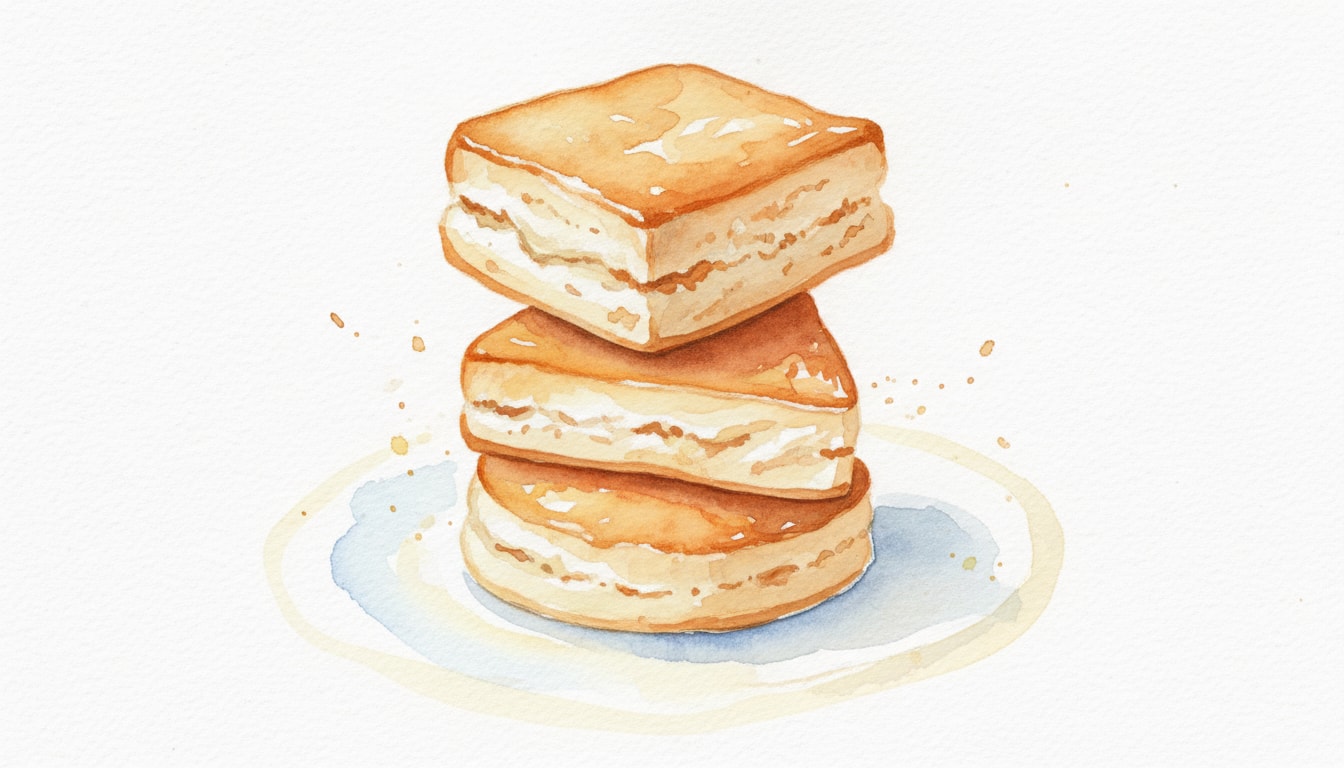
Pat the dough into a final square approximately 20cm x 20cm (8x8 inches) and 2.5cm (1 inch) thick. Using a bench scraper or sharp knife, cut straight down into a 3x3 grid to create 9 equal squares. Do not saw back and forth.
Place squares on the baking sheet, arranging them so they are just barely touching each other. Brush tops with heavy cream if desired.
Bake for 15-18 minutes until well-risen and golden brown on top and bottom. Rotate the pan halfway through for even color.
Chef's Notes
- Temperature is the single most critical variable. If your kitchen is warm (>24°C), freeze the dry ingredients and bowl for 10 minutes before starting.
- The 'geometric' square cut eliminates scrap dough. Re-rolling scraps creates tough biscuits because the gluten structure is overworked.
- Arranging biscuits to touch on the tray creates a 'steam chimney' effect that forces them to rise vertically rather than spreading horizontally.
- For a sweeter British-style scone, increase sugar to 60g and add currants or dried fruit during the folding stage.
Storage
Refrigerator: 2 days — Store in an airtight container; texture degrades quickly in fridge.
Freezer: 3 months — Freeze unbaked squares on a tray, then bag. Bake from frozen adding 3-5 minutes.
Reheating: Reheat at 175°C (350°F) for 5-7 minutes until warm.
Troubleshooting
Biscuits/Scones are flat and heavy
Cause: Butter melted before baking or chemical leavening is old
Fix: Cannot be fixed after baking
Prevention: Keep all ingredients ice cold; check baking powder freshness
Dough is tough
Cause: Overmixing developed gluten
Fix: Cannot be fixed
Prevention: Stop mixing when dough is still shaggy; fold gently
Biscuits lean over or fall sideways
Cause: Uneven cutting technique or dull knife sealing edges
Fix: Cannot be fixed, purely cosmetic
Prevention: Cut straight down with sharp blade; do not twist
Cultural Context
This recipe sits at the intersection of the American South and the British Isles. While the British scone is traditionally associated with tea time and often contains eggs, the Southern biscuit relies on the acidity of buttermilk and a higher fat ratio for tenderness. The square-cut 'cat-head' style is a practical, rural tradition prioritizing efficiency and texture over the manicured round shape.