
Equipment
Ingredients
Pasta
- 340 g dried linguine
- 3000 ml water
- 30 g kosher salt
Creamy Wasabi Base
- 30 g unsalted butter
- 2 garlic, minced
- 115 g cream cheese, room temperature
- 15 ml soy sauce
- 10 g wasabi paste
Cheeses
- 50 g sharp cheddar cheese, freshly grated
- 30 g parmesan cheese, freshly grated
Sushi-Inspired Finish
- 60 g tobiko, chilled
- 20 g scallions, thinly sliced
- 1 roasted seaweed, cut into thin strips
Nutrition (per serving)
Nutrition is estimated per serving. Nutrients without complete source data are omitted.
Full nutrition
- Calories
- 582 kcal
- Protein
- 23 g
- Carbohydrates
- 68 g
- Fat
- 24 g
- Fiber
- 3 g
- Sugar
- 4 g
- Sodium
- 485 mg
- Saturated Fat
- 14 g
- Trans Fat
- 0 g
- Monounsaturated Fat
- 5 g
- Polyunsaturated Fat
- 2 g
- Cholesterol
- 106 mg
- Potassium
- 336 mg
- Calcium
- 242 mg
- Iron
- 1.6 mg
- Magnesium
- 64 mg
- Phosphorus
- 381 mg
- Zinc
- 2.3 mg
- Vitamin A
- 206 mcg
- Vitamin C
- 5 mg
- Vitamin D
- 1.9 mcg
- Vitamin E
- 1.6 mg
- Vitamin K
- 12 mcg
- Vitamin B6
- 0.2 mg
- Vitamin B12
- 1.7 mcg
- Thiamin
- 0.13 mg
- Riboflavin
- 0.27 mg
- Niacin
- 1.9 mg
- Folate
- 36 mcg
- Water
- 48 g
Sources: Aggregated Public Data, USDA FoodData Central
Method
Bring the water and kosher salt to a rolling boil (100°C/212°F) in a large pot. Add the linguine and cook according to package directions until exactly al dente.
While the pasta cooks, melt the unsalted butter in a large skillet over medium-low heat. Add the minced garlic and gently saute until fragrant but not browned.
Add the room temperature cream cheese, soy sauce, wasabi paste, and 60ml of the boiling pasta water to the skillet. Whisk continuously until the cream cheese melts into a smooth base.
Sprinkle the grated sharp cheddar and parmesan cheeses into the skillet, stirring constantly until completely melted. If the sauce is too thick, add more hot pasta water 15ml at a time.
Using tongs, transfer the drained linguine directly into the skillet. Toss the pasta vigorously in the creamy sauce for about one minute so the starches emulsify with the cheeses.
Remove the skillet entirely from the heat source. Allow to cool for 30 seconds, then gently fold in exactly half of the chilled tobiko.
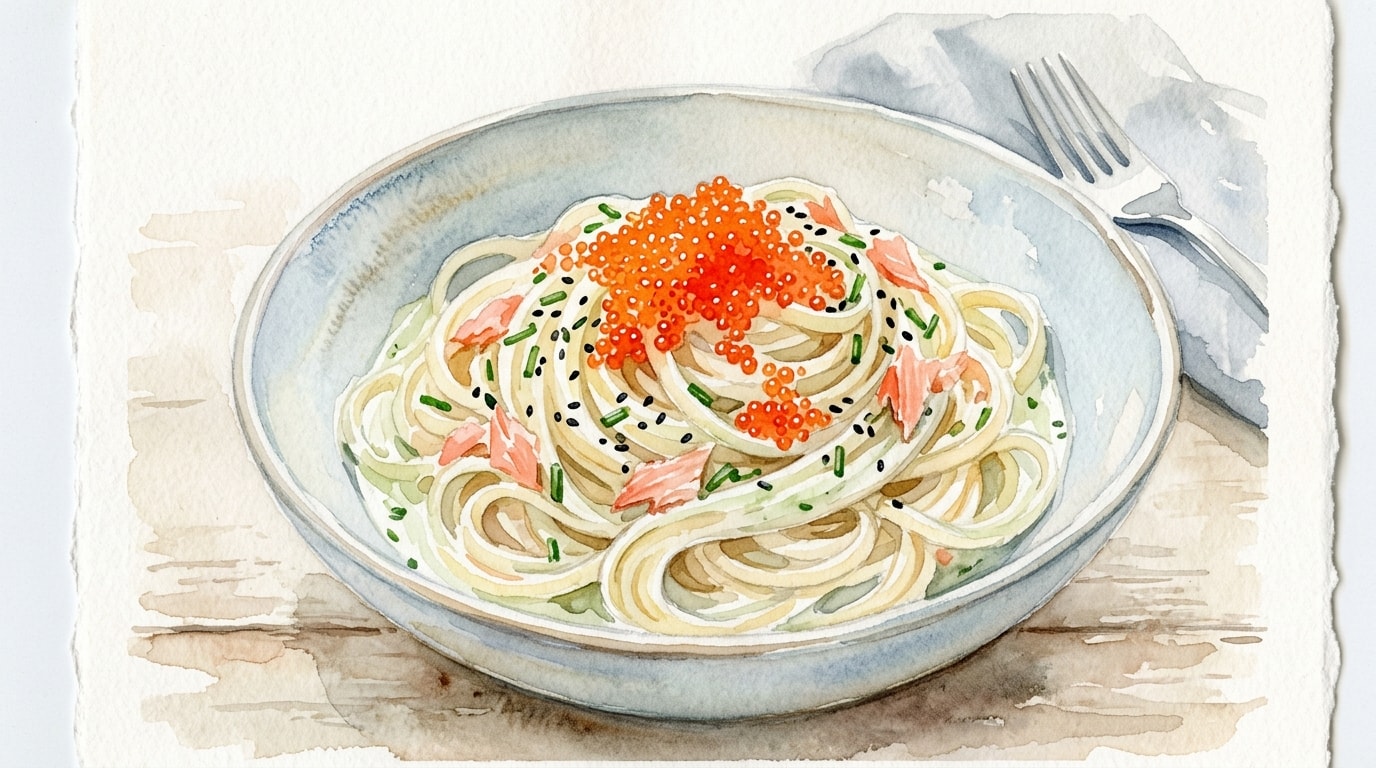
Twirl the pasta into individual serving bowls. Garnish evenly with the remaining tobiko, sliced scallions, and thin strips of roasted seaweed just before serving.
Chef's Notes
- Always use freshly grated cheese. Pre-grated cheeses contain anti-caking agents that will cause a creamy stovetop sauce to turn gritty.
- Tobiko provides a moderate level of briny saltiness. Wait to adjust the final seasoning of the dish until after the soy sauce, cheeses, and roe have been incorporated.
- Heat diminishes the sharp sinus-clearing compound in wasabi (allyl isothiocyanate). If you love a punchy kick, save half the wasabi to fold in at the very end with the tobiko.
- The starchy pasta water is the glue of this dish. It loosens the rich cream cheese and helps the fat bind to the liquid, resulting in a glossy rather than greasy finish.
Storage
Troubleshooting
Sauce is clumpy or separated
Cause: Cream cheese was too cold or skillet was too hot when adding hard cheeses
Fix: Add a splash of hot starchy pasta water and whisk vigorously off the heat to re-emulsify
Prevention: Ensure cream cheese is room temperature and lower the heat before adding cheddar and parmesan
Tobiko turns opaque and hard
Cause: Added while the pan was still over active heat
Fix: Cannot be fixed
Prevention: Always remove the pan from the heat completely before introducing roe
Wasabi flavor is barely noticeable
Cause: Wasabi paste lost its pungency due to prolonged heat exposure
Fix: Stir in a small extra dab of wasabi paste directly into individual portions off the heat
Prevention: Do not boil the sauce after adding wasabi; whisk it in just before adding the pasta
Cultural Context
This dish belongs to a style of Japanese-Italian fusion cooking known as Wafu Pasta, which emerged in Tokyo during the 1950s. By marrying Western pasta techniques with indigenous Japanese ingredients like soy sauce, seaweed, and roe (often mentaiko or tarako), chefs created an entirely new category of comfort food. Here, the concept is adapted using colorful tobiko and a rich, distinctly Western cream cheese and cheddar base.


