
Equipment
Ingredients
Fish
- 300 g sea bass fillets, boneless, skinless
Aromatics & Seasoning
- 1 lemon, thinly sliced
- 5 g fresh thyme, whole sprigs
- 30 ml dry white wine
- 30 g unsalted butter, cold, cut into small cubes
- 3 g salt
- 1 g black pepper, freshly ground
Nutrition (per serving)
Nutrition is estimated per serving. Nutrients without complete source data are omitted.
Full nutrition
- Calories
- 277 kcal
- Protein
- 28 g
- Carbohydrates
- 4 g
- Fat
- 15 g
- Fiber
- 1 g
- Sugar
- 1 g
- Sodium
- 782 mg
- Saturated Fat
- 8 g
- Trans Fat
- 0 g
- Monounsaturated Fat
- 4 g
- Polyunsaturated Fat
- 2 g
- Cholesterol
- 94 mg
- Potassium
- 455 mg
- Calcium
- 39 mg
- Iron
- 1.1 mg
- Magnesium
- 70 mg
- Phosphorus
- 305 mg
- Zinc
- 0.7 mg
- Vitamin A
- 178 mcg
- Vitamin C
- 17 mg
- Vitamin D
- 8.4 mcg
- Vitamin E
- 1.7 mg
- Vitamin K
- 2 mcg
- Vitamin B6
- 0.6 mg
- Vitamin B12
- 0.5 mcg
- Thiamin
- 0.18 mg
- Riboflavin
- 0.19 mg
- Niacin
- 2.4 mg
- Folate
- 11 mcg
- Water
- 142 g
Sources: Aggregated Public Data, USDA FoodData Central
Method
Preheat oven to 200°C/400°F. Cut two large heart shapes out of parchment paper, approximately 38 centimeters wide.
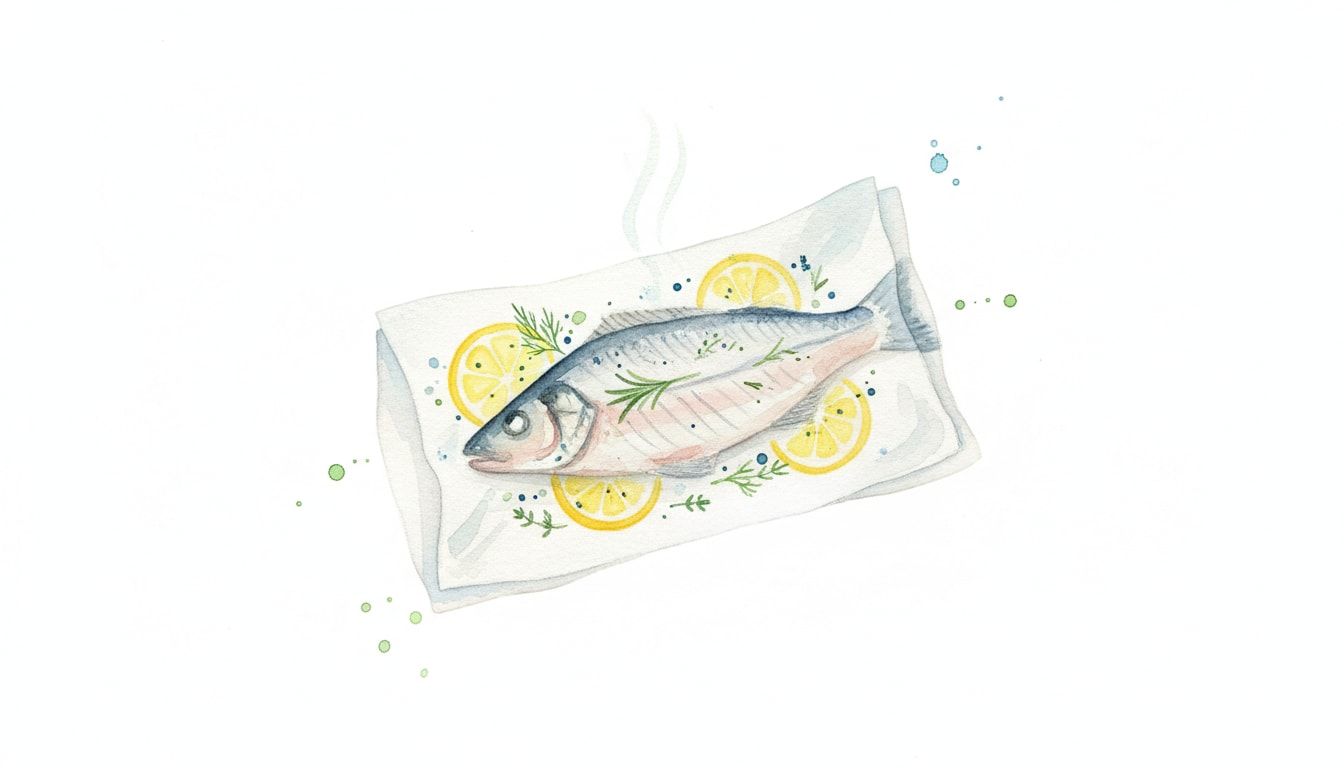
Place lemon slices on one half of each parchment heart. Top with a sea bass fillet and season evenly with salt and black pepper.
Arrange fresh thyme sprigs and cold butter cubes over the seasoned fish. Carefully drizzle the dry white wine over the top.
Fold the empty half of the parchment over the fish. Starting at the top curve, make tight, overlapping folds along the edge to seal the pouch. Twist the bottom tip to secure.
Place the sealed pouches on a baking sheet and bake for 12 to 15 minutes, or until the parchment pouches puff up fully with steam.
Transfer the pouches directly to serving plates. Snip open the top of the parchment at the table to release the steam, taking care to avoid burns.
Chef's Notes
- For an extra secure seal, lightly brush the inside edges of the parchment paper with a beaten egg white before folding and crimping.
- Pouches can be assembled and sealed up to 4 hours in advance and stored in the refrigerator. Add 2 to 3 minutes to the baking time if cooking straight from cold.
- Serve the papillote alongside steamed asparagus or small new potatoes to soak up the highly flavorful broth that forms at the bottom of the pouch.
- Ensure the fish fillets are of even thickness so they cook at the exact same rate. Tuck thinner tail ends under if necessary to create uniform thickness.
Storage
Refrigerator: 1 day — Best eaten immediately. Uncooked assembled pouches can be refrigerated up to 4 hours before baking.
Reheating: Reheating is not recommended as it will dry out the fish.
Troubleshooting
Parchment pouch does not puff up during baking
Cause: The seal was not entirely airtight, allowing crucial steam to escape
Fix: Cannot be fixed once baked, but you can drizzle the fish with extra melted butter to replace lost moisture
Prevention: Make sharp, tight, overlapping creases when folding the edges, pressing down firmly on each fold
Cultural Context
En papillote is a classic French culinary technique dating back centuries, originally utilizing oiled paper to gently steam delicate proteins. This method ensures that volatile aromatic compounds from herbs and wine are completely trapped, deeply infusing the fish while maintaining pristine moisture.


