
Equipment
Ingredients
Pork
- 1200 g pork loin roast, boneless, fat cap intact
Sage and Garlic Rub
- 5 garlic, minced
- 15 g fresh sage leaves, finely chopped
- 30 ml olive oil
- 12 g kosher salt
- 4 g black pepper, coarsely ground
Nutrition (per serving)
Nutrition is estimated per serving. Nutrients without complete source data are omitted.
Full nutrition
- Calories
- 448 kcal
- Protein
- 40 g
- Carbohydrates
- 3 g
- Fat
- 30 g
- Fiber
- 1 g
- Sugar
- 0 g
- Sodium
- 915 mg
- Saturated Fat
- 9 g
- Trans Fat
- 0 g
- Monounsaturated Fat
- 13 g
- Polyunsaturated Fat
- 4 g
- Cholesterol
- 126 mg
- Potassium
- 627 mg
- Calcium
- 119 mg
- Iron
- 2.2 mg
- Magnesium
- 46 mg
- Phosphorus
- 421 mg
- Zinc
- 5.4 mg
- Vitamin A
- 12 mcg
- Vitamin C
- 2 mg
- Vitamin D
- 1.4 mcg
- Vitamin E
- 1.1 mg
- Vitamin K
- 4 mcg
- Vitamin B6
- 0.9 mg
- Vitamin B12
- 1.1 mcg
- Thiamin
- 1.01 mg
- Riboflavin
- 0.63 mg
- Niacin
- 13.4 mg
- Folate
- 0 mcg
- Water
- 138 g
Sources: Aggregated Public Data, USDA FoodData Central
Method
Preheat your oven to 200°C (400°F).
Using a sharp chef's knife, score the fat cap of the pork loin in a diagonal diamond pattern, taking care not to cut too deeply into the meat itself.
In a small bowl, combine the olive oil, minced garlic, chopped fresh sage, kosher salt, and black pepper, stirring until it forms a thick paste.
Rub the sage and garlic paste evenly over the entire pork loin, pressing it firmly into the scored lines of the fat cap.
Place the seasoned pork loin fat-side up in a roasting pan. Roast in the preheated 200°C (400°F) oven for 15 minutes to initiate browning and render the surface fat.
Reduce the oven temperature to 175°C (350°F). Continue roasting for 45 to 55 minutes until a meat thermometer inserted into the thickest center part of the loin reads 63°C (145°F).
Remove the pork loin from the oven and transfer it to a cutting board. Tent it loosely with aluminum foil and let it rest for 15 minutes to allow the juices to redistribute.
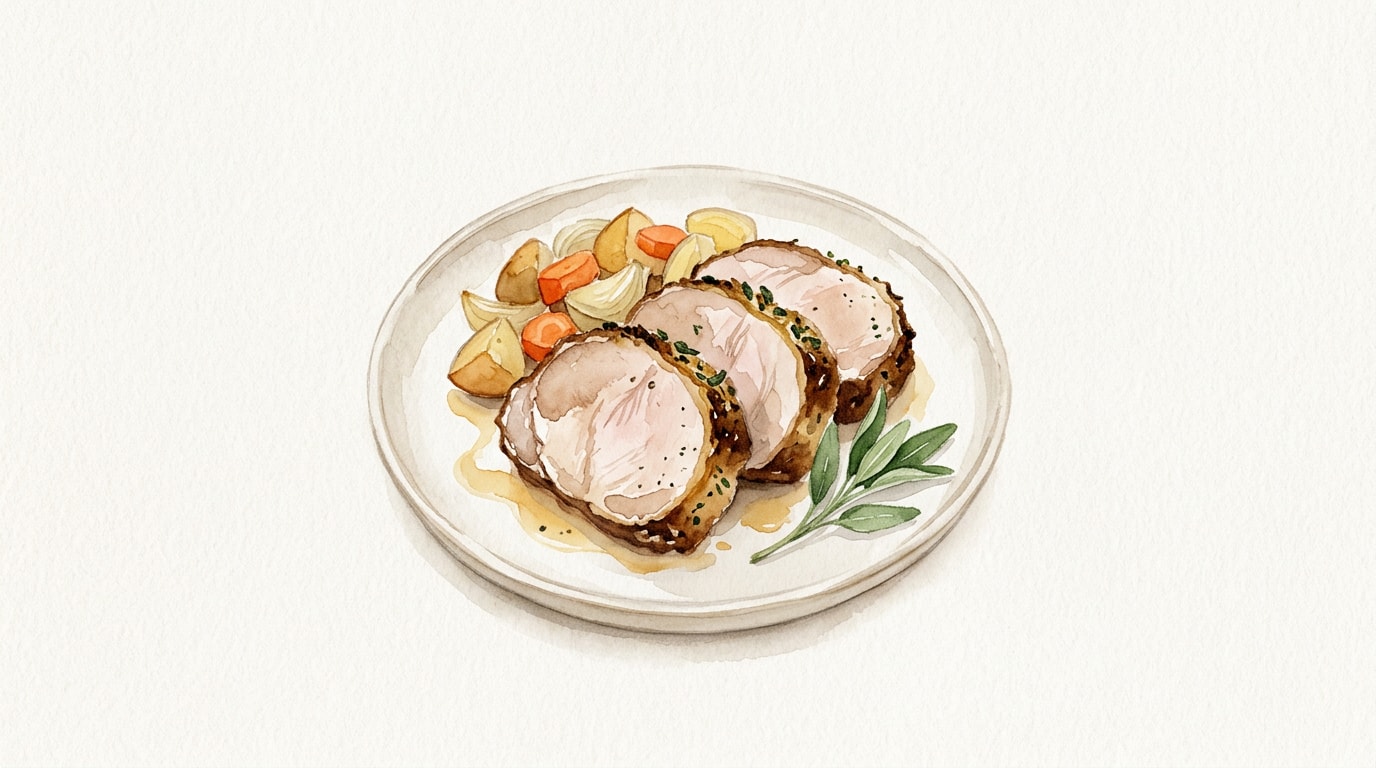
Slice the pork loin into generous medallions against the grain and serve immediately, drizzled with any juices accumulated on the cutting board.
Chef's Notes
- Pork loin is an inherently lean cut. Tying it with kitchen twine before seasoning can help it maintain a uniform cylindrical shape, promoting even roasting from edge to center.
- Do not confuse pork loin with pork tenderloin. The tenderloin is much smaller and cooks significantly faster; substituting one for the other without adjusting times will result in overcooked or raw meat.
- Carryover cooking during the resting phase is absolutely critical. Pulling the roast at exactly 63°C (145°F) yields a perfect, juicy, and safe medium doneness with a slight blush of pink in the center.
- Scoring the fat cap not only looks elegant but also allows the rendering fat to self-baste the lean meat underneath while creating more surface area for the herb rub to penetrate.
Storage
Refrigerator: 4 days — Store in an airtight container or wrap tightly in heavy-duty foil.
Freezer: 2 months — Wrap tightly in plastic wrap and then aluminum foil to prevent freezer burn.
Reheating: Reheat gently in an oven at 150C/300F or in the microwave at 50 percent power with a splash of water or broth to prevent the meat from drying out.
Troubleshooting
Dry and tough pork meat
Cause: The pork loin was overcooked beyond the safe minimum internal temperature of 63°C (145°F).
Fix: Cannot be fixed, but slicing the meat very thinly and serving it with a warm pan gravy or jus can help restore moisture.
Prevention: Use a calibrated instant-read thermometer. Check the temperature 10 minutes before the estimated finish time and pull the roast exactly at 63°C, as carryover cooking will continue to raise the temperature during the resting phase.
Garlic on the exterior is burnt and bitter
Cause: The initial roasting temperature was too high for the size of the minced garlic pieces.
Fix: Scrape off the overly blackened bits of garlic before slicing.
Prevention: Mince the garlic very finely or mash it into a paste before mixing it with the oil to ensure it sits flush against the meat and does not catch the direct heat.
Cultural Context
Roast pork has long been a traditional centerpiece in American and European Sunday dinners, particularly celebrated during the autumn months when herbs like sage are freshly harvested. The pairing of rich, fatty pork with earthy, slightly astringent sage is a culinary classic historically designed to balance the heaviness of the meat and aid in digestion.


