
Equipment
Ingredients
The Goose
- 4500 g whole young goose, thawed, giblets removed
- 30 g coarse sea salt
- 5 g black pepper, freshly ground
Aromatics
- 1 lemon, halved
- 1 yellow onion, halved
- 1 garlic, halved crosswise
- 10 g fresh thyme, whole sprigs
Potatoes
- 1500 g maris piper or yukon gold potatoes, peeled and quartered
Nutrition (per serving)
Nutrition is estimated per serving. Nutrients without complete source data are omitted.
Full nutrition
- Calories
- 3007 kcal
- Protein
- 126 g
- Carbohydrates
- 52 g
- Fat
- 252 g
- Fiber
- 7 g
- Sugar
- 4 g
- Sodium
- 2506 mg
- Saturated Fat
- 73 g
- Monounsaturated Fat
- 134 g
- Polyunsaturated Fat
- 28 g
- Cholesterol
- 600 mg
- Potassium
- 3492 mg
- Calcium
- 158 mg
- Iron
- 21.5 mg
- Magnesium
- 203 mg
- Phosphorus
- 1924 mg
- Zinc
- 13.8 mg
- Vitamin A
- 132 mcg
- Vitamin C
- 98 mg
- Vitamin E
- 0.1 mg
- Vitamin K
- 7 mcg
- Vitamin B6
- 3.8 mg
- Vitamin B12
- 2.5 mcg
- Thiamin
- 0.92 mg
- Riboflavin
- 1.91 mg
- Niacin
- 29.9 mg
- Folate
- 76 mcg
- Water
- 617 g
Sources: USDA FoodData Central
Method
Using a paring knife, prick the goose skin all over, focusing on the fatty breast and legs. Pierce the skin at an angle to avoid puncturing the flesh. Wash hands and thoroughly sanitize all surfaces after handling raw poultry.
Place the goose on a rack in the sink. Slowly pour 2 liters of boiling water over the bird to tighten the skin. Pat completely dry inside and out with paper towels. Rub the coarse sea salt and black pepper evenly over the skin and inside the cavity.
Place the goose on a rack over a roasting pan. Leave uncovered in the refrigerator for at least 24 hours to dry out the skin.
Remove the goose from the refrigerator 1 hour before cooking. Preheat the oven to 220C/430F. Stuff the cavity with the lemon halves, onion halves, garlic bulb, and thyme sprigs.
Roast the goose for 30 minutes at 220C/430F to begin rendering the fat. Then, lower the oven temperature to 170C/340F.
Continue roasting at 170C/340F for about 2 hours. Every 30 minutes, carefully remove the pan and pour off the liquid fat into a heatproof bowl. The goose is safe and done when a meat thermometer inserted into the thickest part of the thigh registers 74C/165F.
While the goose roasts, place the peeled potatoes in a large pot of salted water. Boil for 10 minutes until the outsides are tender but the centers are still firm. Drain in a colander and vigorously shake the potatoes to rough up the edges.
About 45 minutes before serving, pour 100ml of the reserved hot goose fat into a second roasting pan. Add the fluffed potatoes, toss to coat entirely in the fat, and roast alongside the goose at 170C/340F. When the goose is removed to rest, increase the heat to 220C/430F to finish crisping the potatoes for a final 15-20 minutes.
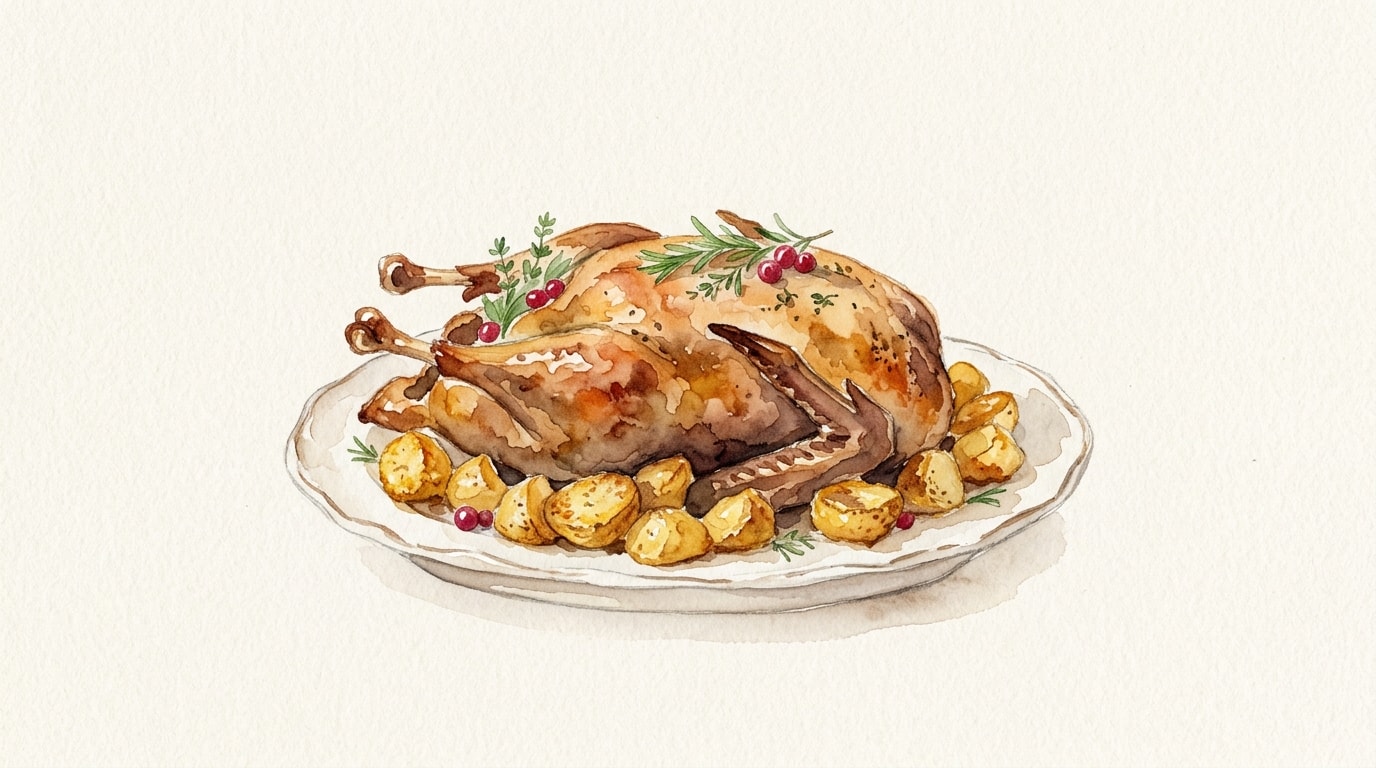
Transfer the cooked goose to a carving board, tent loosely with foil, and let it rest for 30 minutes. Carve and serve alongside the hot, crispy goose fat potatoes.
Chef's Notes
- Geese carry a massive amount of fat under their skin. Pricking creates an escape route for this fat to render out, naturally basting the bird as it roasts.
- Do not skip the boiling water step; it shrinks the skin tight against the meat, which accelerates the rendering process and maximizes crispiness.
- Save every drop of the rendered goose fat. Strained through a coffee filter into a sterilized jar, it will keep in the fridge for six months and makes the world's best roasted root vegetables.
- Because of their anatomy, carving a goose is different from a turkey. It is often easier to remove the entire breast lobe from the bone first, then slice it crosswise on the cutting board.
Storage
Refrigerator: 4 days — Store meat and potatoes in separate airtight containers. Save excess fat in a sterilized jar for up to 6 months.
Freezer: 3 months — Meat freezes beautifully. Do not freeze the roasted potatoes.
Reheating: Reheat meat gently wrapped in foil at 160C. Recrisp potatoes and skin in a 200C oven.
Troubleshooting
Goose skin is flabby and pale instead of crisp
Cause: The bird was not dried long enough or the oven temperature was too low
Fix: Place the carved pieces of skin under a hot broiler for 2 to 3 minutes, watching closely to prevent burning
Prevention: Always dry the goose uncovered in the fridge for 24 hours and ensure your oven runs true to temperature
Meat is dry and stringy
Cause: Flesh was punctured during the pricking phase or the bird was overcooked
Fix: Serve with an abundant amount of hot gravy to add moisture back to the meat
Prevention: Prick the skin at a shallow, nearly horizontal angle and use a meat thermometer to monitor internal temperature
Cultural Context
Long before the turkey arrived from the Americas, the goose was the undisputed king of the European holiday table. Traditionally eaten at Michaelmas in autumn and deeply tied to Christmas feasts in Britain and Germany, raising a goose provided vital calories for harsh winters. The rich, dark meat was prized for its robust flavor, while its voluminous fat was carefully stored to provide cooking oil for the entire year.


