Equipment
* optional
Ingredients
Roux Base
- 50 g unsalted butter, cubed
- 50 g all-purpose flour, sifted
Liquid and Seasoning
- 500 ml fish stock
- 2 g fine sea salt
- 1 g white pepper, ground
Nutrition (per serving)
Nutrition is estimated per serving. Nutrients without complete source data are omitted.
Full nutrition
- Calories
- 62 kcal
- Protein
- 2 g
- Carbohydrates
- 4 g
- Fat
- 5 g
- Fiber
- 0 g
- Sugar
- 0 g
- Sodium
- 156 mg
- Saturated Fat
- 3 g
- Monounsaturated Fat
- 1 g
- Polyunsaturated Fat
- 0 g
- Cholesterol
- 11 mg
- Potassium
- 79 mg
- Calcium
- 4 mg
- Iron
- 0.1 mg
- Magnesium
- 5 mg
- Phosphorus
- 35 mg
- Zinc
- 0.1 mg
- Vitamin A
- 35 mcg
- Vitamin C
- 0 mg
- Vitamin E
- 0.2 mg
- Vitamin K
- 0 mcg
- Vitamin B6
- 0.0 mg
- Vitamin B12
- 0.3 mcg
- Thiamin
- 0.02 mg
- Riboflavin
- 0.04 mg
- Niacin
- 0.7 mg
- Folate
- 2 mcg
- Water
- 50 g
Sources: USDA FoodData Central
Method
Pour the fish stock into a small saucepan and bring to a gentle simmer around 85°C/185°F. Keep warm over very low heat.
In a medium saucepan, melt the unsalted butter over medium-low heat until it foams but does not take on any color.
Whisk the sifted all-purpose flour into the melted butter to form a smooth paste, creating the roux.
Cook the roux gently over medium-low heat for 2 to 3 minutes, stirring constantly. It should smell toasted like pie crust but remain pale yellow in color.
Gradually ladle the hot fish stock into the hot roux in three additions. Whisk vigorously after each addition to ensure a perfectly smooth, lump-free base before adding more liquid.
Once all the stock is incorporated, bring the mixture to a gentle boil to activate the thickening properties of the flour.
Reduce the heat to the lowest setting and simmer gently for 15 minutes. Use a ladle to continuously skim off any foam or impurities that rise to the surface.
Remove from heat. Season with fine sea salt and white pepper to taste. If any trace lumps remain, strain through a fine mesh sieve before using or storing.
Chef's Notes
- Always match the temperature of your ingredients: hot stock into a warm roux prevents temperature shock that leads to clumping.
- When a recipe calls for reducing a veloute, hold back on initial seasoning. As water evaporates, the salt concentration intensifies rapidly.
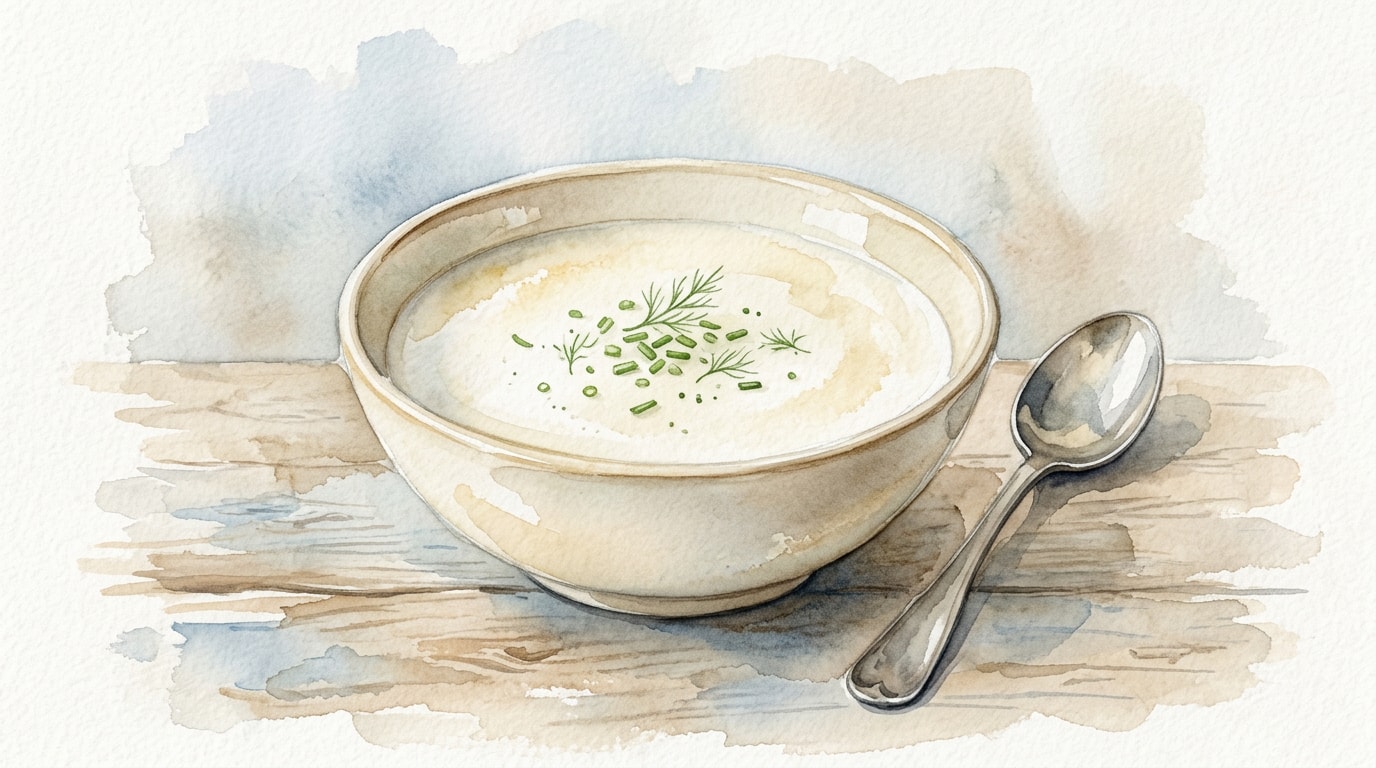
- A proper veloute should perfectly coat the back of a spoon (nappe) and leave a clean line when you run your finger through it.
- To prevent a skin from forming while cooling a veloute, gently glide a cube of cold butter over the hot surface to create a protective lipid layer.
Storage
Refrigerator: 3 days — Cover surface directly with plastic wrap or a buttered cartouche to prevent a skin from forming.
Freezer: 1 month — May separate slightly upon thawing. Whisk vigorously over gentle heat to re-emulsify.
Reheating: Reheat gently over low heat, whisking constantly. If the sauce becomes too thick, thin with a splash of hot fish stock.
Troubleshooting
Sauce has lumps
Cause: Stock was added too quickly or mixture was not whisked thoroughly during addition.
Fix: Vigorously whisk the sauce or pass it through a fine mesh sieve. An immersion blender can also save a very lumpy sauce.
Prevention: Add hot stock gradually in distinct batches, whisking until completely smooth between additions.
Raw flour taste
Cause: The roux was not cooked long enough before adding the liquid, or the final sauce was not simmered adequately.
Fix: Simmer the sauce for an additional 10 to 15 minutes, adding a splash of water or stock if it becomes too thick.
Prevention: Ensure the roux is cooked for at least 2 minutes until it smells toasted.
Sauce is too thick and heavy
Cause: Too much liquid evaporated during simmering, or ingredient measurements were inaccurate.
Fix: Whisk in additional hot fish stock or hot water, one tablespoon at a time, until the desired consistency is reached.
Prevention: Simmer at a very low heat rather than a rolling boil, and measure flour by weight.
Cultural Context
Veloute is one of the five original mother sauces of classical French cuisine, famously categorized by Chef Auguste Escoffier in the early 20th century. Translating to velvety, a fish veloute serves as the structural foundation for countless secondary classical sauces, including Sauce Normande, Sauce Bercy, and Sauce Vin Blanc.