Equipment
Ingredients
Sponge
- 200 g unsalted butter, softened to room temperature
- 200 g caster sugar
- 200 g self-raising flour, sifted
- 4 large eggs
- 2 ml vanilla extract
- 30 ml whole milk
- 1 g pink gel food coloring
Assembly and Coating
- 150 g apricot jam, smooth and seedless preferred
- 15 ml lemon juice
- 450 g marzipan, at cool room temperature and pliable
- 20 g powdered sugar, for dusting during rolling
Nutrition (per serving)
Nutrition is estimated per serving. Nutrients without complete source data are omitted.
Full nutrition
- Calories
- 702 kcal
- Protein
- 9 g
- Carbohydrates
- 98 g
- Fat
- 30 g
- Fiber
- 2 g
- Sugar
- 72 g
- Sodium
- 346 mg
- Saturated Fat
- 14 g
- Potassium
- 192 mg
- Calcium
- 149 mg
- Iron
- 2.4 mg
- Magnesium
- 46 mg
- Phosphorus
- 272 mg
- Zinc
- 1.0 mg
- Vitamin A
- 215 mcg
- Vitamin C
- 2 mg
- Water
- 38 g
Sources: Aggregated Public Data, USDA FoodData Central
Method
Preheat the oven to 175°C (350°F). Grease the two 20cm square cake tins with butter and line the bases with parchment paper.
In a mixing bowl, beat the softened butter and caster sugar together with an electric mixer on medium-high speed for 4-5 minutes, until the mixture is pale, light and fluffy.
Add the eggs one at a time, beating well after each addition. If the mixture begins to curdle, beat in a tablespoon of the sifted flour to bring it back together.
Mix in the vanilla extract briefly. Sift in the self-raising flour and fold gently with a spatula until just combined, taking care not to overmix.
Divide the batter evenly between two mixing bowls. Add the pink gel food coloring to one bowl and fold gently until the color is uniform and vivid throughout.
Spoon the plain batter into one prepared tin and the pink batter into the other. Spread each level with a spatula and tap the tins firmly on the counter to release any large air bubbles.
Bake both tins on the middle rack of the preheated oven at 175°C (350°F) for 22-25 minutes, until the sponges are golden, spring back when pressed lightly, and a skewer inserted into the centre emerges clean.
Leave the sponges to cool in their tins for 10 minutes, then turn them out onto a cooling rack, peel off the parchment and cool completely to room temperature before assembly.
Using a long sharp knife and a ruler, trim each cooled sponge into a neat rectangle of equal dimensions, discarding the dark crusts. Slice each rectangle in half lengthwise to produce four long strips of identical size.
In a small saucepan over low heat, warm the apricot jam with the lemon juice for 2-3 minutes until loose and spreadable. Sieve out any fruit pieces for a smooth glaze.
Place one pink strip on a sheet of parchment. Brush its long cut side with warm jam, then press a yellow strip against it to form a paired block. Repeat with the remaining two strips, joining yellow to pink in the opposite order so the colors alternate.
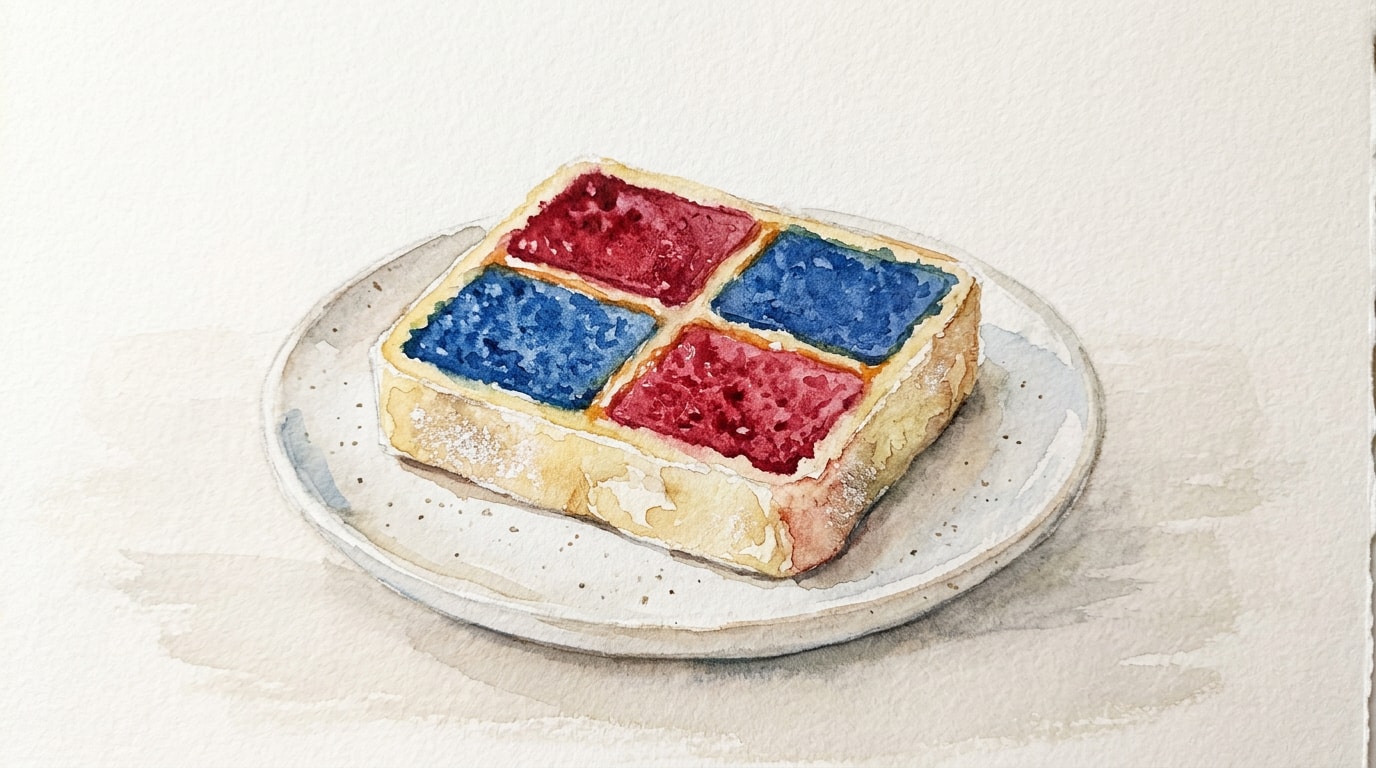
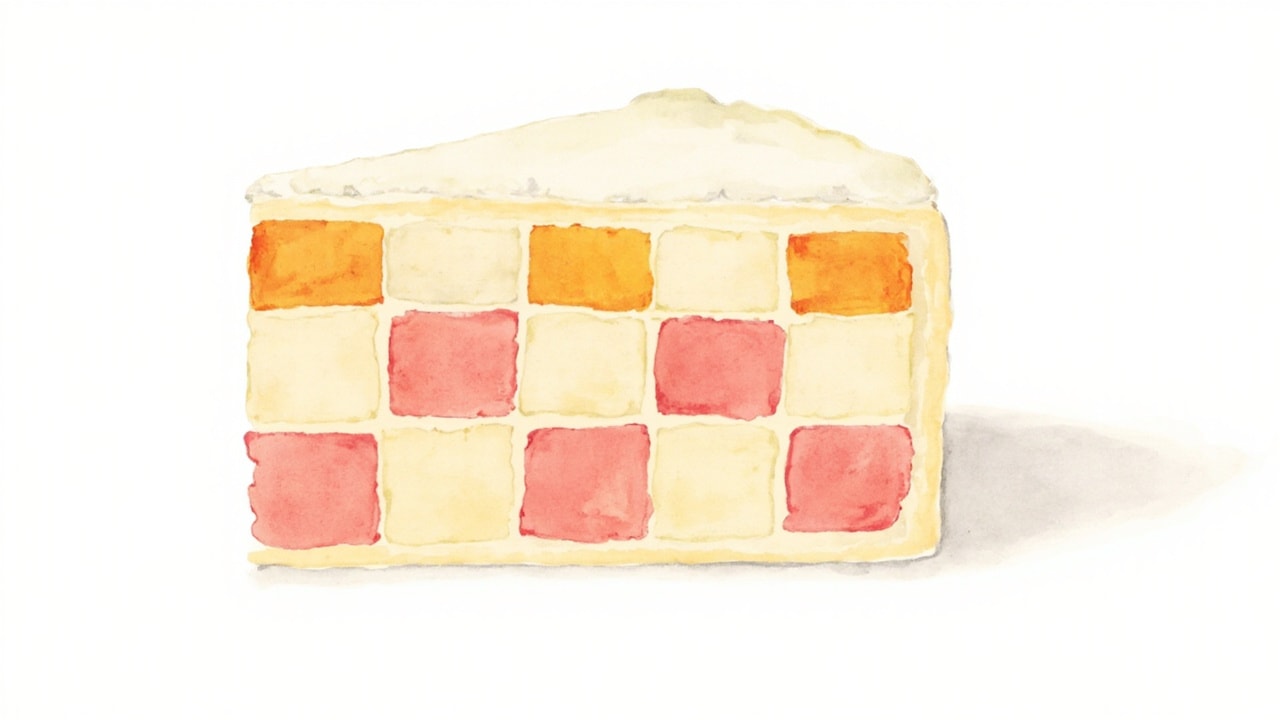
Brush the top of each paired block with warm jam. Stack one block on top of the other, offsetting so the colors create a four-square checkerboard when viewed from the end. Press gently to adhere.
Brush the remaining warm jam over all exposed sides of the stacked cake, coating evenly so the marzipan will stick firmly to every surface.
Dust the work surface lightly with powdered sugar and roll the marzipan into a rectangle roughly 30cm by 25cm, about 5mm thick.
Place the jam-coated cake in the centre of the rolled marzipan. Lift one long edge of marzipan up and over the top of the cake and smooth it down, then bring the opposite edge up to meet it and press the seam together. Trim any excess at the ends.
Turn the cake seam-side down and trim the marzipan flush with the ends. Crimp the edges decoratively with a knife or your fingertips, then slice with a hot, dry knife to reveal the checkerboard pattern within.
Chef's Notes
- Sieve the apricot jam even if it looks smooth; tiny fruit fragments can tear the marzipan and interrupt clean slices.
- Chill the assembled, jam-coated cake for 20 minutes before wrapping in marzipan so the strips firm up and hold their shape under pressure.
- For natural colour, replace the pink gel with 1 teaspoon of beetroot powder bloomed in a teaspoon of warm milk and folded into half the batter.
- Bake the sponges a day ahead and wrap tightly once cool; slightly stale cake trims and assembles far more cleanly than fresh, fragile crumb.
Storage
Refrigerator: 1 week — Store in an airtight container so the marzipan does not dry out or absorb fridge aromas.
Freezer: 3 months — Wrap tightly in plastic film then foil; thaw overnight in the refrigerator before serving.
Reheating: Best served at room temperature. Remove from the refrigerator about 30 minutes before slicing.
Troubleshooting
Marzipan tears while wrapping
Cause: Marzipan is too cold or has been rolled too thin
Fix: Patch small tears with trimmed excess and smooth the seam; dust with powdered sugar to disguise
Prevention: Keep the marzipan at cool room temperature and roll to a uniform 5mm thickness
Sponge is dense and heavy
Cause: Overmixing after adding the flour, or ingredients were not at room temperature
Fix: Cannot be fixed once baked
Prevention: Fold the flour in gently and ensure butter and eggs are properly tempered before starting
Sponge sticks to the tin
Cause: Insufficient greasing or lining, or the sponge was not rested before turning out
Fix: Cannot be fully fixed; trim any stuck portions from the base before assembly
Prevention: Grease thoroughly, line the bases with parchment, and rest for at least 10 minutes before removing
Checkerboard pattern is uneven or misaligned
Cause: Strips were not cut to identical sizes or were joined out of order
Fix: Cannot be fixed once assembled; disassemble and reassemble with freshly trimmed strips
Prevention: Use a ruler and label each strip as you cut, then mirror the join order for the second pair
Marzipan surface looks dull or develops a white bloom
Cause: Temperature fluctuation during storage or condensation on the surface
Fix: Brush lightly with a tiny amount of neutral oil or warm the surface with your hands to restore sheen
Prevention: Store in an airtight container away from moisture and direct sunlight
Cultural Context
The Battenburg cake is a classic English tea cake believed to commemorate the 1884 marriage of Princess Victoria, granddaughter of Queen Victoria, to Prince Louis of Battenberg. Its alternating squares are said to represent the four Battenberg princes, while the marzipan coat echoes the rich almond confections of Victorian patisserie. It remains a fixture of British afternoon tea, served at weddings, christenings and celebratory teas across the United Kingdom.