
Equipment
Ingredients
Seafood & Marinade
- 500 g firm white fish fillets, cut into 5cm chunks
- 300 g large shrimp, peeled and deveined
- 45 ml lime juice, freshly squeezed
- 3 garlic, minced
- 6 g kosher salt
Stew Base
- 30 ml dende oil
- 1 yellow onion, sliced into thin rings
- 1 red bell pepper, sliced into thin rings
- 1 yellow bell pepper, sliced into thin rings
- 400 g diced tomatoes, canned or fresh
- 400 ml full-fat coconut milk
- 15 g fresh cilantro, roughly chopped
Nutrition (per serving)
Nutrition is estimated per serving. Nutrients without complete source data are omitted.
Full nutrition
- Calories
- 504 kcal
- Protein
- 41 g
- Carbohydrates
- 17 g
- Fat
- 33 g
- Fiber
- 3 g
- Sugar
- 6 g
- Sodium
- 746 mg
- Saturated Fat
- 23 g
- Monounsaturated Fat
- 5 g
- Polyunsaturated Fat
- 2 g
- Cholesterol
- 172 mg
- Potassium
- 1154 mg
- Calcium
- 180 mg
- Iron
- 5.9 mg
- Magnesium
- 125 mg
- Phosphorus
- 558 mg
- Zinc
- 2.8 mg
- Vitamin A
- 139 mcg
- Vitamin C
- 126 mg
- Vitamin E
- 1.9 mg
- Vitamin K
- 14 mcg
- Vitamin B6
- 0.6 mg
- Vitamin B12
- 2.5 mcg
- Thiamin
- 0.10 mg
- Riboflavin
- 0.16 mg
- Niacin
- 3.0 mg
- Folate
- 70 mcg
- Water
- 350 g
Sources: Aggregated Public Data, USDA FoodData Central
Method
Place the fish chunks and shrimp in a mixing bowl. Add the lime juice, minced garlic, and salt. Toss gently to combine and set aside to marinate for 15 minutes.
Using a chef knife and cutting board, slice the onion and both bell peppers into thin, uniform rings.
Heat half of the dende oil in a large Dutch oven over medium heat. Add the sliced onions and bell peppers, stirring occasionally until they begin to soften, about 5 minutes.
Lower the heat to medium-low. Layer the diced tomatoes over the softened vegetables, followed by the marinated fish chunks, leaving the shrimp in the bowl for later. Pour the coconut milk evenly over the top.
Bring the stew to a gentle simmer at approximately 90C or 195F. Cover the Dutch oven tightly and let cook undisturbed for 10 minutes.
Remove the lid and gently nestle the marinated shrimp into the simmering broth. Cover and cook for an additional 5 minutes until the shrimp turn completely pink and opaque, and all seafood reaches a safe internal temperature of 63C or 145F.
Remove the pot from the heat. Drizzle the remaining dende oil over the surface and scatter the fresh chopped cilantro evenly across the top.
Ladle the hot stew into shallow bowls, ensuring an even distribution of broth, fish, shrimp, and vegetables.
Chef's Notes
- Dende oil (unrefined palm oil) is strictly essential for authentic Moqueca Baiana, providing the signature bright orange color and a unique earthy, deeply savory flavor.
- Choose thick, firm white fish fillets like halibut, cod, or mahi-mahi. Delicate fish like tilapia or sole will disintegrate into the broth during simmering.
- Layering is important in traditional moqueca. Do not stir the pot once the fish and coconut milk have been added; gently shaking the pot side to side is preferred to mix flavors without breaking the proteins.
- Serve this stew over simple long-grain white rice with a side of farofa (toasted cassava flour) to absorb the rich, flavorful broth.
Storage
Refrigerator: 3 days — Store in an airtight container. Reheat gently to prevent overcooking the seafood.
Reheating: Reheat gently on the stovetop over low heat until just warmed through.
Troubleshooting
Seafood is rubbery and dry
Cause: The fish and shrimp were boiled at too high a temperature or left in the pot too long
Fix: Cannot be fixed
Prevention: Maintain a very gentle simmer and only add the shrimp during the final 5 minutes of cooking
Coconut milk broth has separated or looks curdled
Cause: The stew reached a rolling boil, causing the coconut milk to split
Fix: Stir in a splash of warm water and vigorously swirl the pot off the heat to encourage re-emulsification
Prevention: Ensure the heat is kept at medium-low so the liquid stays at a gentle simmer
Cultural Context
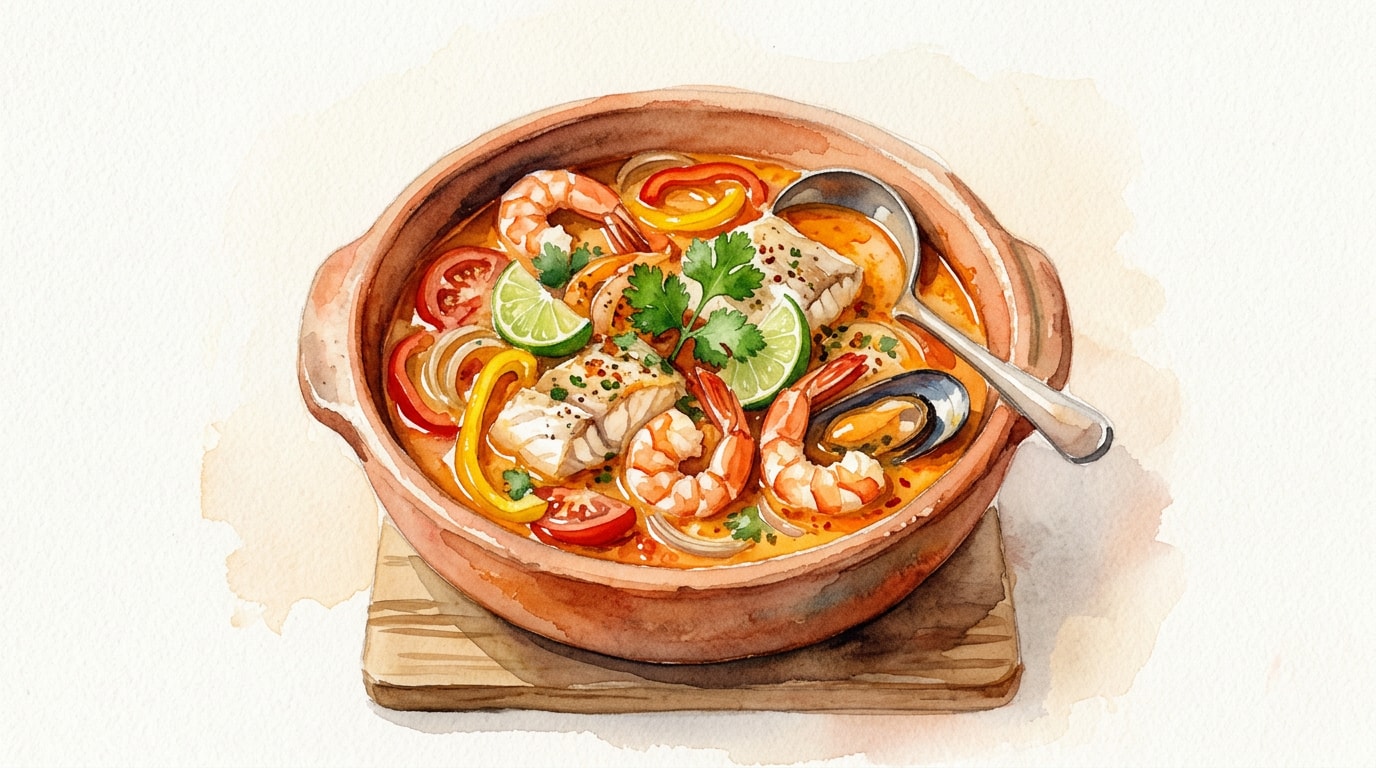
Moqueca Baiana is a cornerstone of Afro-Brazilian cuisine, originating in the state of Bahia in northeastern Brazil. The dish masterfully blends indigenous Brazilian techniques with Portuguese and West African ingredients, most notably the use of dende oil and coconut milk introduced via the transatlantic slave trade. It is traditionally cooked and served in a handmade black clay pot called a panela de barro.


