
Equipment
Ingredients
Monkfish & Stuffing
- 800 g monkfish tail fillets, cleaned, grey membrane fully removed
- 200 g pork sausage meat, removed from casings if using linked sausages
- 100 g yellow onion, finely diced
- 10 g fresh sage, finely chopped
- 250 g streaky bacon, thinly sliced
Roasted Vegetables
- 300 g carrots, peeled and cut into batons
- 300 g parsnips, peeled and cut into batons
- 30 ml olive oil
- salt
- black pepper
Cranberry Dressing
- 100 g smooth cranberry sauce
- 30 ml olive oil, extra virgin
- 15 ml red wine vinegar
Nutrition (per serving)
Nutrition is estimated per serving. Nutrients without complete source data are omitted.
Full nutrition
- Calories
- 786 kcal
- Protein
- 48 g
- Carbohydrates
- 39 g
- Fat
- 51 g
- Fiber
- 9 g
- Sugar
- 17 g
- Sodium
- 1709 mg
- Saturated Fat
- 10 g
- Trans Fat
- 0 g
- Monounsaturated Fat
- 22 g
- Polyunsaturated Fat
- 15 g
- Cholesterol
- 93 mg
- Potassium
- 1672 mg
- Calcium
- 132 mg
- Iron
- 4.4 mg
- Magnesium
- 106 mg
- Phosphorus
- 607 mg
- Zinc
- 3.2 mg
- Vitamin A
- 667 mcg
- Vitamin C
- 22 mg
- Vitamin D
- 0.7 mcg
- Vitamin E
- 8.5 mg
- Vitamin K
- 36 mcg
- Vitamin B6
- 1.1 mg
- Vitamin B12
- 2.3 mcg
- Thiamin
- 3.07 mg
- Riboflavin
- 0.60 mg
- Niacin
- 13.3 mg
- Folate
- 110 mcg
- Water
- 388 g
Sources: Aggregated Public Data, USDA FoodData Central
Method
Preheat your oven to 200 degrees Celsius (400 degrees Fahrenheit).
Place the carrot and parsnip batons on a roasting tray. Drizzle with 30ml of olive oil, season generously with salt and pepper, and toss until evenly coated.
Roast the vegetables in the preheated oven for 35 minutes, turning halfway through, until golden brown and tender.
While the vegetables roast, heat a frying pan over medium heat. Sauté the diced onion and sausage meat together until the pork is thoroughly browned and reaches a safe internal temperature of 74 degrees Celsius (165 degrees Fahrenheit). Break the meat into small crumbles as it cooks.
Transfer the cooked sausage mixture to a mixing bowl. Stir in the chopped fresh sage and set aside to cool slightly.
Butterfly the monkfish fillets by slicing horizontally down the length of the flesh, taking care not to cut all the way through, allowing you to open the fish like a book.
Spoon the slightly cooled sausage and sage mixture into the center crease of the monkfish fillets. Close the fish over the stuffing, then wrap tightly in overlapping slices of streaky bacon to hold the parcel together.
Heat the oven-proof frying pan over medium-high heat. Carefully place the bacon-wrapped monkfish into the hot pan seam-side down. Sear for 3 to 4 minutes to seal the bacon edges, then gently roll to brown the remaining sides for another 2 to 3 minutes.
Transfer the oven-proof pan containing the monkfish directly into the oven to finish cooking alongside the vegetables. Bake for 12 to 15 minutes, or until the fish reaches an internal temperature of 63 degrees Celsius (145 degrees Fahrenheit).
While the monkfish bakes, whisk together the cranberry sauce, red wine vinegar, and remaining 30ml of extra virgin olive oil in a small bowl to create the dressing.
Remove the monkfish from the oven and transfer to a cutting board. Let it rest for 5 minutes to allow the juices to redistribute.
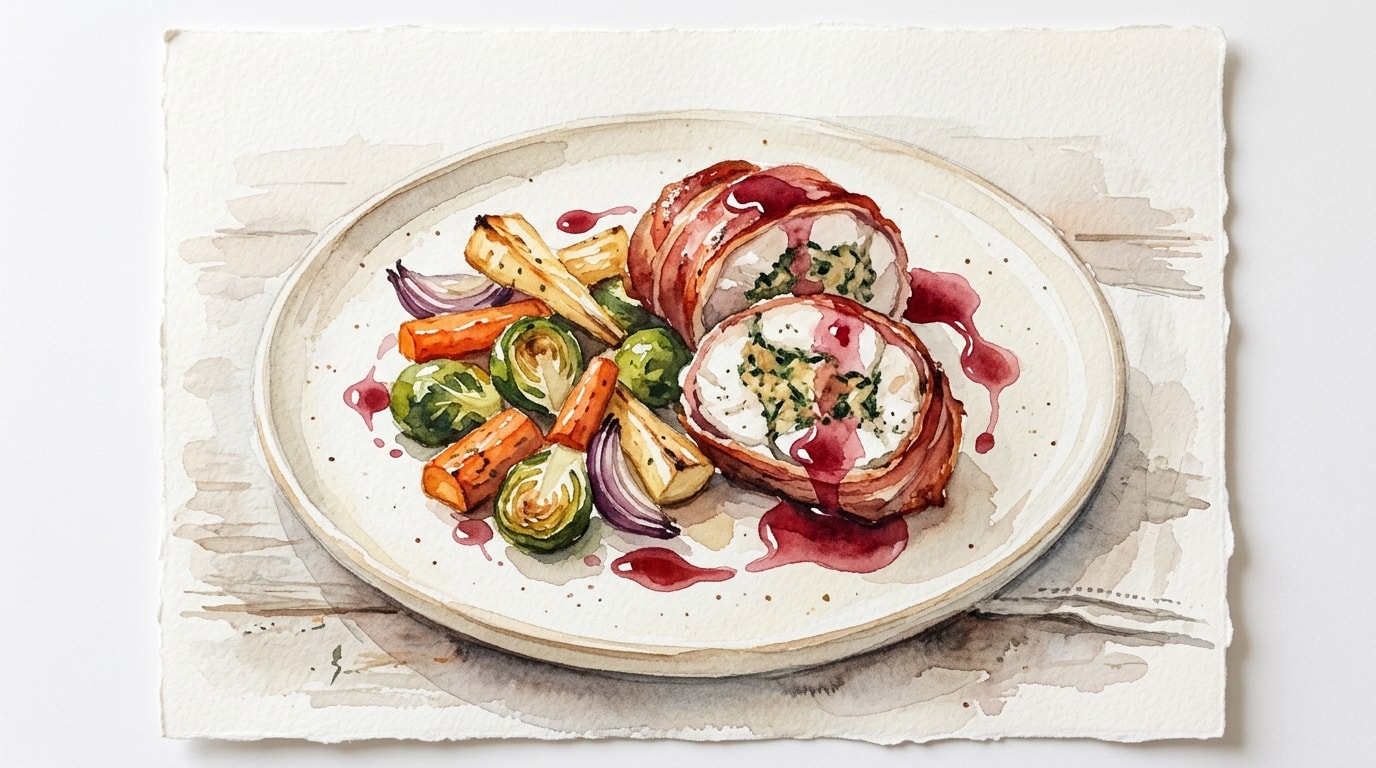
Slice the rested monkfish into thick medallions. Serve immediately over a bed of the hot roasted vegetables and drizzle generously with the tart cranberry dressing.
Chef's Notes
- Monkfish has an incredibly dense, meaty structure often compared to lobster. This makes it uniquely suited among fish for robust techniques like stuffing, wrapping, and roasting without falling apart.
- Raw pork sausage must reach an internal temperature of 74C (165F) to be safe for consumption. Because monkfish cooks optimally at 63C (145F), pre-cooking the stuffing as instructed is a crucial culinary safeguard that prevents you from having to overcook the delicate seafood just to make the center safe.
- The bacon serves a dual purpose here: it acts as a physical barrier to insulate the lean monkfish from the intense oven heat, while the rendering fat naturally bastes the fish, injecting moisture and a profound smoky flavor.
- If your cranberry sauce is particularly stiff, you can warm it gently in the microwave for 10 seconds before whisking in the oil and vinegar to help it emulsify into a smooth dressing.
Storage
Refrigerator: 2 days — Store in an airtight container. The bacon will lose its crispness once refrigerated.
Reheating: Reheat in a 180C (350F) oven for 10-12 minutes until warmed through to help recrisp the bacon.
Troubleshooting
The bacon unraveled while cooking in the pan.
Cause: The monkfish was placed into the pan seam-side up, or the pan was not hot enough to seal the fat.
Fix: Secure the bacon gently with toothpicks during the remainder of the cooking process, remembering to remove them before serving.
Prevention: Ensure you place the parcel into the pan exactly where the bacon ends meet (seam-side down) to allow the heat to seal it shut.
The monkfish has a tough, rubbery texture.
Cause: The thin grey membrane was left on the fish prior to cooking, which tightens like a rubber band under heat.
Fix: Cannot be fixed
Prevention: Thoroughly inspect the monkfish fillets and use a sharp knife to pull away and trim any silvery or grey membrane covering the white flesh.
Cultural Context
Historically considered an ugly bycatch and nicknamed poor man's lobster, monkfish has risen to prominence as a premium ingredient in Modern British and European kitchens. This preparation marries the seafood with deeply traditional English flavor profiles, utilizing sage, onion, and pork stuffing typical of a Sunday roast, creating an elegant fusion of land and sea.


